

Climate Change Analyst
Overview and Key Facts


Education

Median Pay

Job Growth

Jobs in 2034
What Do They Do?
A climate change analyst could...


Overview Listen to this section
How is climate change affecting Earth? What will the changes mean for society? If these are questions that peak your curiosity, then you might be interested in a job as a climate change analyst. Climate change analysts evaluate climate data and research to determine how shifts in the climate will affect natural resources, animals, and civilizations. They use this information to make suggestions about what individuals and governments can do to ensure a higher-quality life for everyone in the face of a changing environment.
Do You Have the Skills and Characteristics of a Climate Change Analyst?

Core Tasks
Think about if you'd like the typical tasks a Climate Change Analyst might do:Salary & Job Openings
Median Salary (Yearly Pay)
Future Jobs
Blast-Off:
(10% or higher)
(7% - 10%)
(5% - 7%)
(3% - 5%)
(0% - 3%)

Steps to Get There: Becoming a Climate Change Analyst
High School Subjects to Study
Engineering
Career Pathway Listen to this section
A bachelor's degree in environmental science or a related field is necessary to become a climate change analyst. Analysts who would like to focus primarily on the policy side of climate change can more easily get their first job with just a bachelor's degree. Students who would like to be more heavily involved in the science and mathematical modeling aspects of climate change analysis will also need a graduate degree (masters or PhD).
Informal training in the form of internships or time spent working in a climate-change-related science lab is also important. Since climate change analysis focuses on the junction of math, science, economics, and public policy, this is a key way of gaining first-hand skills and experience that might not be taught in the classroom.
Education- Typical Degree Needed After High School Listen to this section
high school credential
Typical degree for an entry-level position: Bachelor's degree ?
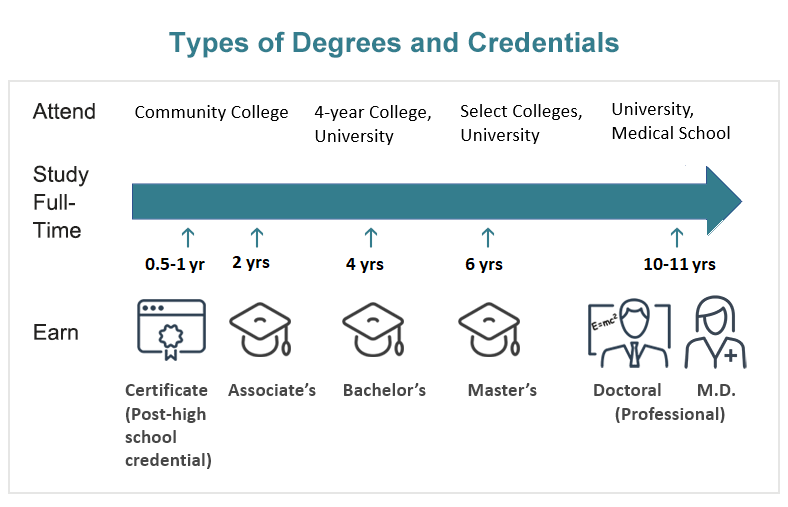
At minimum, a bachelor's degree in a scientific field is required to enter the climate change analyst career track. Strong job candidates usually hold a bachelor's degree in environmental science, or a related field, with an emphasis on understanding weather or the environment, and resource conservation. Students interested in pursuing a career in climate change analysis should also take college courses in math, statistics, computer science, and physics. This is particularly important for students who would like their careers to focus on the science and modeling aspects of climate change. Students who plan to pursue the policy side of climate change should take a heavier course load in public policy and economics.
Although it is possible to work as a climate change analyst with just a bachelor's degree, employment opportunities increase with a graduate degree. This is particularly true for students interested in the more modeling-intensive career path. For these students, a masters degree or PhD in environmental science, computer science, or mathematics is helpful. Job candidates who would like to focus more on the policy aspects of climate change might benefit from a masters degree or PhD in either public policy or in environmental science.
Companies That Hire Climate Change Analysts
Try it Out with an Activity or Project
STEM Activities
STEM activities are fun hands-on explorations that usually take from 10 minutes to one hour and use readily available household or classroom materials while introducing you to STEM concepts common in this career.


Science Project Ideas
Project Ideas are in-depth STEM explorations that have a strong focus on controlling variables, taking accurate measurements, and analyzing data suitable for investigating the scientific method or the engineering design process.


On the Job
Role Models

Nature of the Work
Climate change analysts evaluate scientific data and research about the climate. The climate data often includes, but is not limited to, information about atmospheric temperature, ocean conditions, ice masses, and greenhouse gases. They use this data to create models and to make predictions about what will happen to Earth's climate in the future, and what impacts, if any, these changes will have on natural ecosystems and civilizations. They evaluate both economic and physical impacts.
Although all climate change analysts have to be well-versed in both science and policy, an analyst's career typically focuses more heavily on either one aspect or the other. Climate change analysts who focus on science are more heavily involved in detailed mathematical modeling of the scientific data. They collaborate closely with the scientists who are gathering the climate data and work with them to analyze the information and put it in context with current environmental practices. They might also model how changes to existing government policies can alter climate change effects. Climate change analysts who focus on policy deal less with primary data; instead, they evaluate the published body of climate data and work to draw higher-level conclusions and make predictions from multiple studies. They then use these predictions to lobby for or against specific policy changes. Climate change analysts involved in policy spend a lot of time communicating their findings to non-scientific audiences like lawmakers, corporations, and the general public.
Work Environment
Climate change analysts spend most of their working hours indoors. A substantial amount of time is spent in front of the computer working on analyzing data and writing papers and speeches. 40-hour work weeks within normal business hours are typical for most analysts. Climate change analysts whose jobs also include a large policy or public education component might have require some additional evening and weekend work time when they are giving speeches or organizing events to highlight climate change issues.
More Information
Ask Questions
Do you have a specific question about a career as a Climate Change Analyst that isn't answered on this page? Post your question on the Science Buddies Ask an Expert Forum.
Sources
- U.S. Bureau of Labor Statistics BLS (2024). Occupational Outlook Handbook (OOH), 2024 Edition, Bureau of Labor Statistics. Retrieved August 25, 2025.
- National Center for O*NET Development O*Net Online (2024). National Center for O*Net Development. Retrieved August 25, 2025
- National Academy of Sciences. (2011). Inteviews: Inez Fung. Retrieved July 1, 2019.
- World Bank Institue. (2008, May 19). nterview on Climate Change with Habiba Gitay. Retrieved July 1, 2019.
- NOVA ScienceNOW. (2010, January). Gavin Schmidt: Climate Scientist. The Secret Life of Scientists. Retrieved May 19, 2010.