

Electrician
Overview and Key Facts


Education

Median Pay

Job Growth

Jobs in 2034
What Do They Do?
An electrician could...


Overview Listen to this section
Electricians are the people who bring electricity to our homes, schools, businesses, public spaces, and streets—lighting up our world, keeping the indoor temperature comfortable, and powering TVs, computers, and all sorts of machines that make life better. Electricians install and maintain the wiring and equipment that carries electricity, and they also fix electrical machines.
Do You Have the Skills and Characteristics of an Electrician?

Core Tasks
Think about if you'd like the typical tasks an Electrician might do:Salary & Job Openings
Median Salary (Yearly Pay)
Future Jobs
Blast-Off:
(10% or higher)
(7% - 10%)
(5% - 7%)
(3% - 5%)
(0% - 3%)

Steps to Get There: Becoming an Electrician
High School Subjects to Study
Engineering
Career Pathway Listen to this section
Most electricians learn their trade through apprenticeship programs. These programs combine on-the-job training with related classroom instruction.
Education- Typical Degree Needed After High School Listen to this section
high school credential
Typical degree for an entry-level position: Post high school credential ?
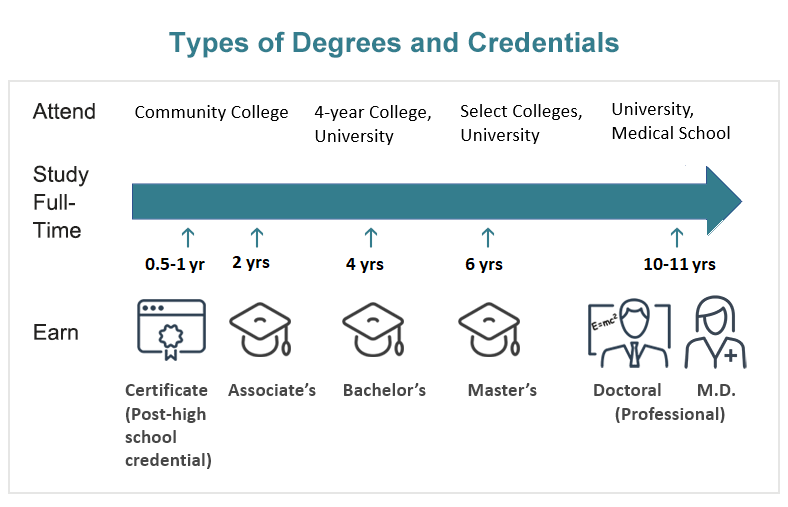
Most electricians learn their trade through apprenticeship programs. These programs combine paid on-the-job training with related classroom instruction. Joint training committees made up of local unions of the International Brotherhood of Electrical Workers and local chapters of the National Electrical Contractors Association; individual electrical contracting companies; or local chapters of the Associated Builders and Contractors and the Independent Electrical Contractors Association usually sponsor apprenticeship programs.
Because of the comprehensive training received, those who complete apprenticeship programs qualify to do both maintenance and construction work. Apprenticeship programs usually last 4 years. Each year includes at least 144 hours of classroom instruction and 2,000 hours of on-the-job training. In the classroom, apprentices learn electrical theory, blueprint reading, mathematics, electrical code requirements, and safety and first aid practices. They also may receive specialized training in soldering, communications, fire alarm systems, and cranes and elevators. On the job, apprentices work under the supervision of experienced electricians.
Some people start their classroom training before seeking an apprenticeship. A number of public and private vocational-technical schools and training academies offer training to become an electrician. Employers often hire students who complete these programs and usually start them at a more advanced level than those without this training. A few people become electricians by first working as helpers—assisting electricians by setting up job sites, gathering materials, and doing other nonelectrical work—before entering an apprenticeship program. All apprentices need a high school diploma or a General Equivalency Diploma (G.E.D.). Electricians may also need classes in mathematics because they solve mathematical problems on the job.
Education can continue throughout an electrician's career. Electricians often complete regular safety programs, manufacturer-specific training, and management training courses. Classes on installing low-voltage voice, data, and video systems have recently become common as these systems become more prevalent. Other courses teach electricians how to become contractors.
Licensure. Most states and localities require electricians to be licensed. Although licensing requirements vary from state to state, electricians must usually pass an examination that tests their knowledge of electrical theory, the National Electrical Code, and local electric and building codes. Experienced electricians periodically take courses offered by their employer or union to learn about changes in the National Electrical Code.
Electrical contractors who do electrical work for the public, as opposed to electricians who work for electrical contractors, often need a special license. In some states, electrical contractors need certification as master electricians. Most states require master electricians to have at least 7 years of experience as an electrician. Some states require a bachelor's degree in electrical engineering or a related field.
Companies That Hire Electricians
Try it Out with an Activity or Project
STEM Activities
STEM activities are fun hands-on explorations that usually take from 10 minutes to one hour and use readily available household or classroom materials while introducing you to STEM concepts common in this career.


Science Project Ideas
Project Ideas are in-depth STEM explorations that have a strong focus on controlling variables, taking accurate measurements, and analyzing data suitable for investigating the scientific method or the engineering design process.


On the Job
Role Models

Nature of the Work
Electricians bring electricity into homes, businesses, and factories. They install and maintain the wiring, fuses, and other components through which electricity flows. Many electricians also install and maintain electrical machines in factories.
Electricians usually start their work by reading blueprints. Blueprints are technical diagrams that show the locations of circuits, outlets, load centers, panel boards, and other equipment. To ensure public safety, electricians follow the National Electrical Code, and state and local building codes.
Electricians connect all types of wires to circuit breakers, transformers, outlets, or other components. They join the wires in boxes with various specially designed connectors. When installing wiring, electricians use hand tools, such as conduit benders, screwdrivers, pliers, knives, hacksaws, and wire strippers, as well as power tools, such as drills and saws. Later, they use ammeters, ohmmeters, voltmeters, oscilloscopes, and other equipment to test connections and ensure the compatibility and safety of components.
Electricians generally focus on either construction or maintenance, although many do both. Electricians specializing in construction primarily install wiring systems into factories, businesses, and new homes. Electricians specializing in maintenance work fix and upgrade existing electrical systems and repair electrical equipment.
When electricians install wiring systems in factories and commercial settings, they first place conduit (pipe or tubing) inside partitions, walls, or other concealed areas, as designated by the blueprints. They also fasten small metal or plastic boxes to the walls that will house electrical switches and outlets. They pull insulated wires or cables through the conduit to complete circuits between these boxes. In residential construction, electricians usually install insulated wire encased in plastic, which does not need to run through conduit.
Some electricians also install low-voltage wiring systems, in addition to electrical systems, although line installers and repairers specialize in this work. Low-voltage wiring accommodates voice, data, and video equipment, such as telephones, computers, intercoms, and fire alarm and security systems. Electricians also may install coaxial or fiber optic cable for telecommunications equipment and electronic controls for industrial uses.
Maintenance electricians repair or replace electric and electronic equipment when it breaks. They make needed repairs as quickly as possible in order to minimize inconvenience. They may replace items such as circuit breakers, fuses, switches, electrical and electronic components, or wire. Electricians also periodically inspect all equipment to ensure it is operating properly and to correct problems before breakdowns occur.
Maintenance work varies greatly, depending on where an electrician works. Electricians who focus on residential work perform a wide variety of electrical work for homeowners. They may rewire a home and replace an old fuse box with a new circuit breaker box to accommodate additional appliances, or they may install new lighting and other electric household items, such as ceiling fans. These electricians might also do some construction and installation work.
Electricians in large factories usually do maintenance work that is more complex. They may repair motors, transformers, generators, and electronic controllers on machine tools and industrial robots. Electricians also advise management whether continued operation of equipment could be hazardous. When working with complex electronic devices, they may consult with engineers, engineering technicians, line installers and repairers, or industrial machinery mechanics and maintenance workers.
Work Environment
Electricians work indoors and out, at construction sites, in homes, and in businesses or factories. Work may be strenuous at times, and may include bending conduit, lifting heavy objects, and standing, stooping, and kneeling for long periods of time. Electricians risk injury from electrical shock, falls, and cuts. They must follow strict safety procedures to avoid injuries. When working outdoors, they may be subject to inclement weather conditions. Some electricians may have to travel long distances to job sites.
Most electricians work a standard 40-hour week, although overtime may be required. Those who do maintenance work may work nights or weekends and be on-call to go to the job site, when needed. Electricians in industrial settings may have periodic extended overtime during scheduled maintenance or retooling periods. Companies that operate 24 hours a day may employ three shifts of electricians.
More Information
Ask Questions
Do you have a specific question about a career as an Electrician that isn't answered on this page? Post your question on the Science Buddies Ask an Expert Forum.
Additional Resources
For details about apprenticeships or other work opportunities in this trade, contact the offices of your state employment service, your state apprenticeship agency, local electrical contractors or firms that employ maintenance electricians, or local union-management electrician apprenticeship committees.
Information also may be available from local chapters of the Independent Electrical Contractors, Inc.; the National Electrical Contractors Association; the Home Builders Institute; the Associated Builders and Contractors; and the International Brotherhood of Electrical Workers.
For information about union apprenticeship and training programs, contact:
- National Joint Apprenticeship Training Committee: www.njatc.org
- National Electrical Contractors Association: www.necanet.org
For information about independent apprenticeship programs, contact:
- Associated Builders and Contractors: www.abc.org
- Independent Electrical Contractors, Inc.: www.ieci.org
- National Association of Home Builders: www.nahb.org
- National Center for Construction Education and Research: www.nccer.org
Sources
- U.S. Bureau of Labor Statistics BLS (2024). Occupational Outlook Handbook (OOH), 2024 Edition, Bureau of Labor Statistics. Retrieved August 25, 2025.
- National Center for O*NET Development O*Net Online (2024). National Center for O*Net Development. Retrieved August 25, 2025
- Electric TV. (2012). Walt Disney World - Powered by the NECA/IBEW Team. Retrieved February 27, 2019.
- Rongey, D. (2009). Troubleshooting Home Electrical Wiring. Retrieved July 30, 2009.