
/-/https/careerdiscovery.sciencebuddies.org/cdn/Files/21464/5/sb-logo.png)
Aerospace Engineering & Operations Technician
Overview and Key Facts
/-/https/careerdiscovery.sciencebuddies.org/cdn/Files/842/17/unsplash-Bt9HIKC0Nus.jpg)

Education

Median Pay

Job Growth

Jobs in 2034
What Do They Do?
An aerospace engineering and operations technician could.../-/https/careerdiscovery.sciencebuddies.org/cdn/Files/843/17/iStock-177424662.jpg)
/-/https/careerdiscovery.sciencebuddies.org/cdn/Files/17526/9/air-force-fighter-jets-pegasus.jpg)
/-/https/careerdiscovery.sciencebuddies.org/cdn/Files/845/17/pexels-photo-23763.jpg)
/-/https/careerdiscovery.sciencebuddies.org/cdn/Files/846/17/pexels-photo-586097.jpg)
/-/https/careerdiscovery.sciencebuddies.org/cdn/Files/843/17/iStock-177424662.jpg)
/-/https/careerdiscovery.sciencebuddies.org/cdn/Files/17526/9/air-force-fighter-jets-pegasus.jpg)
/-/https/careerdiscovery.sciencebuddies.org/cdn/Files/845/17/pexels-photo-23763.jpg)
/-/https/careerdiscovery.sciencebuddies.org/cdn/Files/846/17/pexels-photo-586097.jpg)
Overview Listen to this section
Aerospace engineering and operations technicians are essential to the development of new aircraft and space vehicles. They build, test, and maintain parts for air and spacecraft, and assemble, test, and maintain the vehicles as well. They are key members of a flight readiness team, preparing space vehicles for launch in clean rooms, and on the launch pad. They also help troubleshoot launch or flight failures by testing suspect parts./-/https/i.ytimg.com/vi/4v6zxdzda2Y/hqdefault.jpg)
Do You Have the Skills and Characteristics of an Aerospace Engineering & Operations Technician?

- Critical Thinking ?
- Quality Control Analysis ?
- Reading Comprehension ?
- Operations Monitoring ?
- Active Listening ?
Core Tasks
Think about if you'd like the typical tasks an Aerospace Engineering & Operations Technician might do:Salary & Job Openings
Median Salary (Yearly Pay)
Future Jobs
Blast-Off:
(10% or higher)
(7% - 10%)
(5% - 7%)
(3% - 5%)
(0% - 3%)

Steps to Get There: Becoming an Aerospace Engineering & Operations Technician
High School Subjects to Study
Engineering
Career Pathway Listen to this section
Most aerospace engineering and operations technicians enter the occupation with an associate degree in engineering technology. Training is available at technical institutes, community colleges, extension divisions of colleges and universities, public and private vocational-technical schools, and in the Armed Forces. Because the type and quality of training programs vary considerably, prospective students should carefully investigate training programs before enrolling.
Education- Typical Degree Needed After High School Listen to this section
high school credential
Typical degree for an entry-level position: Associate's degree ?
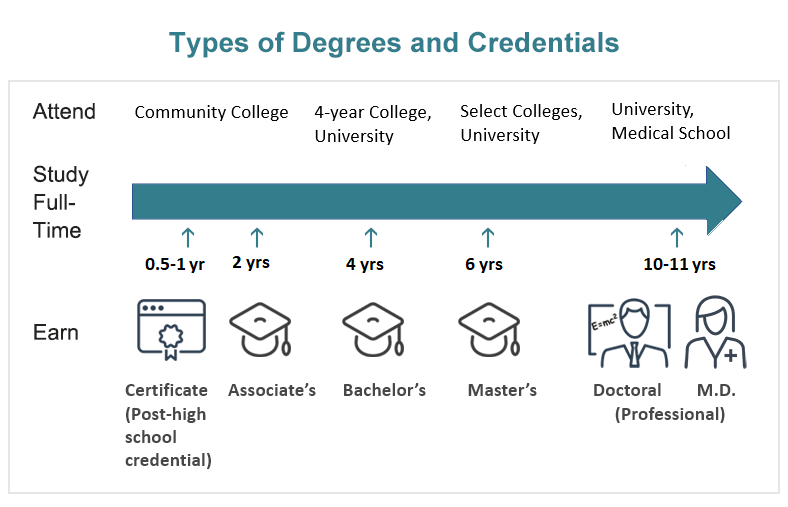
There are several ways to train to become an aerospace engineering and operations technician. In high school you should take as many math and science classes as possible. You can then attend a college or technical school and take a two-year program in engineering or aerospace technology. Some schools have work-study programs in which you attend classes while working in the industry. Some companies in the aerospace industry offer on-the-job training programs. Apprenticeship programs, such as those given in drafting and electronics, may lead to a technician's job. Graduates of technical schools run by the armed services may also be able to find jobs as aerospace engineering and operations technicians. In addition, there are home-study courses that can qualify you for a job as a technician in the aerospace industry. Technicians may have to pass a security clearance before they can work on defense projects.
Companies That Hire Aerospace Engineering & Operations Technicians
Try it Out with an Activity or Project
STEM Activities
STEM activities are fun hands-on explorations that usually take from 10 minutes to one hour and use readily available household or classroom materials while introducing you to STEM concepts common in this career.
/-/https/www.sciencebuddies.org/cdn/Files/15246/4/paper-rocket-thumbnail2.jpg)
/-/https/www.sciencebuddies.org/cdn/Files/5933/5/paper-planes-folded.jpg)
/-/https/www.sciencebuddies.org/cdn/Files/12322/7/diy-parachute-thumbnail.jpg)
/-/https/www.sciencebuddies.org/cdn/Files/15723/9/bottle-rocket-in-action-thumbnail.jpg)
/-/https/www.sciencebuddies.org/cdn/Files/15272/5/whirlybird-in-action-thumbnail.jpg)
/-/https/www.sciencebuddies.org/cdn/Files/12820/5/sls_booster_sep.jpg)
/-/https/www.sciencebuddies.org/cdn/Files/16484/4/IMG_0629.JPG)
/-/https/www.sciencebuddies.org/cdn/Files/15317/6/paper-helicopter-mars-thumbnail.jpg)
/-/https/www.sciencebuddies.org/cdn/Files/15377/6/match-rockets-ready-to-go-off-thumbnail.jpg)
/-/https/www.sciencebuddies.org/cdn/Files/6029/9/sled-kite-tails.jpg)
/-/https/www.sciencebuddies.org/cdn/Files/5924/8/hovercraft-homemade-mini.jpg)
/-/https/www.sciencebuddies.org/cdn/Files/6024/6/frisbee-grass.jpg)
Science Project Ideas
Project Ideas are in-depth STEM explorations that have a strong focus on controlling variables, taking accurate measurements, and analyzing data suitable for investigating the scientific method or the engineering design process.
/-/https/www.sciencebuddies.org/Files/12708/11/aero-plane-design-cut-flaps.jpg)
/-/https/www.sciencebuddies.org/Files/8482/8/candle-carousel-thumb.jpg)
/-/https/www.sciencebuddies.org/Files/5099/10/monarch-butterfly-on-flower_img.jpg)
/-/https/www.sciencebuddies.org/cdn/Files/19768/15/parachuter-sky.jpg)
/-/https/www.sciencebuddies.org/cdn/Files/15722/4/rocket-blastoff-thumbnail.jpg)
/-/https/www.sciencebuddies.org/cdn/Files/3850/5/Phys_img101.jpg)
/-/https/www.sciencebuddies.org/Files/3262/10/Aero_img053.jpg)
/-/https/www.sciencebuddies.org/cdn/Files/6221/11/frisbee-launch-angles.jpg)
/-/https/www.sciencebuddies.org/Files/3884/10/Aero_img080.jpg)
/-/https/www.sciencebuddies.org/Files/7098/12/whirly-bird.jpg)
/-/https/www.sciencebuddies.org/Files/3561/10/Aero_img071.gif)
/-/https/www.sciencebuddies.org/Files/15676/11/model-rocket-aerodynamics-stability.jpg)
/-/https/www.sciencebuddies.org/cdn/Files/18103/7/water-bottle-rocket-payload-thumbnail.jpg)
/-/https/www.sciencebuddies.org/cdn/Files/4481/8/Aero_p033_figure2.jpg)
/-/https/www.sciencebuddies.org/cdn/Files/15651/10/model-rockets-three.jpg)
/-/https/www.sciencebuddies.org/Files/12089/9/aero-wing-tip-thumbnail.jpg)
/-/https/www.sciencebuddies.org/Files/4169/10/Aero_img091.jpg)
/-/https/www.sciencebuddies.org/Files/20839/6/blobid1728327550071.jpg)
/-/https/www.sciencebuddies.org/cdn/Files/5163/10/kites_img.jpg)
/-/https/www.sciencebuddies.org/cdn/Files/2808/13/Aero_img042.gif)
On the Job
Role Models

Nature of the Work
The aerospace industry is based on aeronautics, the science of flight, and on astronautics, the science of space travel. Both aircraft and spacecraft are produced in this industry. Aerospace engineering and operations technicians construct, test, and maintain aircraft and space vehicles. They may work on rockets, missiles, helicopters, and airplanes. They may adjust test equipment for accuracy and determine causes of equipment malfunctions. Using computer and communications systems, aerospace engineering and operations technicians often record and interpret test data. Technicians in the aerospace industry may work on many kinds of projects.
Most aerospace engineering and operations technicians work for companies that build aircraft and space vehicles. These companies have contracts to build this equipment for private airlines or the federal government. Some aerospace engineering and operations technicians work for the National Aeronautics and Space Administration (NASA), universities, or research institutes. Although much of this industry is located on the west coast, some companies in the aerospace industry are located in the south or along the east coast.
Due to the complexity of the aerospace industry, there is great variety in the type of work available for technicians. Many technicians specialize in certain kinds of equipment, such as air intake valves for jet engines. Some spend several years working on small, one-of-a-kind parts used in spaceships. Others specialize in certain kinds of systems, such as hydraulic, electrical, or mechanical systems. They may also work with aircraft instruments, sheet metal, or landing gear.
No matter what kind of equipment they work on, aerospace engineering and operations technicians generally work as part of a team under the direction of scientists or engineers. Technicians perform much of the routine work, allowing the scientists and engineers to focus on tasks that make use of their more advanced training.
Aerospace engineering and operations technicians work in all phases of their industry including research and development, production, and sales. Some technicians prepare precise drawings or scale models. Others work with special instruments to take measurements, collect information, or perform laboratory tests. They may write reports, make cost estimates, or prepare plans for the manufacture of equipment. Some aerospace engineering and operations technicians work as field representatives. They offer assistance and advice to their company's customers, such as NASA or the armed services. Other technicians work as technical writers, preparing information for instruction manuals or catalogs.
Work Environment
Aerospace engineering and operations technicians usually work in modern, well-equipped plants, laboratories, or offices. At times they must work in small spaces, such as the inside sections of space vehicles. Production lines or testing centers can be very noisy. Workers are given ear protectors if the noise level is dangerous. Aerospace engineering and operations technicians sometimes work nights and weekends, but 35-40-hour weeks are standard. At times technicians must work longer hours to complete a project on time. When their projects are completed, aerospace engineering and operations technicians must find other jobs. They may have to move to a new area to find a job requiring their special skills.
Aerospace engineering and operations technicians generally work as part of a team that includes scientists, engineers, and technologists. They must be able to work well with others. They should also have an aptitude for science and mathematics and be able to concentrate on the details of their work. Technicians need to be responsible people who can work well with their hands. Some aerospace engineering and operations technicians belong to unions.
More Information
Ask Questions
Do you have a specific question about a career as an Aerospace Engineering & Operations Technician that isn't answered on this page? Post your question on the Science Buddies Ask an Expert Forum.
Additional Resources
- American Institute of Aeronautics and Astronautics: www.aiaa.org
- American Society for Engineering Education: https://www.asee.org/
Sources
- U.S. Bureau of Labor Statistics BLS (2024). Occupational Outlook Handbook (OOH), 2024 Edition, Bureau of Labor Statistics. Retrieved August 25, 2025.
- National Center for O*NET Development O*Net Online (2024). National Center for O*Net Development. Retrieved August 25, 2025
- Net Industries. (2009). Aerospace Engineering and Operations Technician Job Description, Career as a Aerospace Engineering and Operations Technician, Salary, Employment - Definition and Nature of the Work, Education and Training Requirements, Getting the Job. Retrieved August 10, 2009.
- The Franklin Institute. (1998, June 11). People Who Test and Inspect 'Em. Retrieved March 19, 2014.
- Connecticut Business and Industry Association. (2008, December 19). Aerospace Technician. Retrieved December 8, 2009.
- GadBall. (2007, July 9). Aerospace Engineering and Operations Technicians. Retrieved December 9, 2009.
- DreamItDoItIndiana.com. (2010, March 30). Engineering Technician. Retrieved March 19, 2014.