
/-/https/careerdiscovery.sciencebuddies.org/cdn/Files/21464/5/sb-logo.png)
Landscape Architect
Overview and Key Facts
/-/https/careerdiscovery.sciencebuddies.org/cdn/Files/1396/17/iStock-473199834.jpg)

Education

Median Pay

Job Growth

Jobs in 2034
What Do They Do?
A landscape architect could…/-/https/careerdiscovery.sciencebuddies.org/cdn/Files/1397/17/pexels-photo-808466.jpg)
/-/https/careerdiscovery.sciencebuddies.org/cdn/Files/1398/17/unsplash-nXJyZLBnyUQ.jpg)
/-/https/careerdiscovery.sciencebuddies.org/cdn/Files/1399/17/pexels-photo-2944542.jpg)
/-/https/careerdiscovery.sciencebuddies.org/cdn/Files/1400/17/pexels-photo-1209978.jpg)
/-/https/careerdiscovery.sciencebuddies.org/cdn/Files/1397/17/pexels-photo-808466.jpg)
/-/https/careerdiscovery.sciencebuddies.org/cdn/Files/1398/17/unsplash-nXJyZLBnyUQ.jpg)
/-/https/careerdiscovery.sciencebuddies.org/cdn/Files/1399/17/pexels-photo-2944542.jpg)
/-/https/careerdiscovery.sciencebuddies.org/cdn/Files/1400/17/pexels-photo-1209978.jpg)
Overview Listen to this section
Have you ever visited a new city and marveled at how nice looking it was? Perhaps the streets were wide, the public places were well organized, and the parks and gardens were green and had lots of attractive plants. Well, what you experienced was a well-balanced and designed landscape plan put together by a landscape architect. Landscape architects design everything that is outside of buildings. Their goal is to make a design that is functional, but one that is well balanced with nature and in which people feel happy and comfortable. Landscape architecture is the perfect blend of engineering, art, and nature./-/https/i.ytimg.com/vi/N6VAIuVVL3k/hqdefault.jpg)
Do You Have the Skills and Characteristics of a Landscape Architect?

Core Tasks
Think about if you'd like the typical tasks a Landscape Architect might do:Salary & Job Openings
Median Salary (Yearly Pay)
Future Jobs
Blast-Off:
(10% or higher)
(7% - 10%)
(5% - 7%)
(3% - 5%)
(0% - 3%)

Steps to Get There: Becoming a Landscape Architect
High School Subjects to Study
Engineering
Career Pathway Listen to this section
Almost every state requires landscape architects to be licensed. While requirements vary among the states, they usually include a degree in landscape architecture from an accredited school; work experience; and a passing score on the Landscape Architect Registration Examination, or LARE.
As of 2009, 49 states required landscape architects to be licensed. Licensing is based on the LARE, sponsored by the Council of Landscape Architectural Registration Boards, and administered in two portions, a graphic portion and a multiple-choice portion. Applicants wishing to take the exam usually need a degree from an accredited school plus one to four years of work experience under the supervision of a licensed landscape architect, although standards vary by state. For those without an accredited landscape architecture degree, most states provide alternative paths to qualify to take the LARE, usually requiring more work experience. Currently, 13 states require that a state examination be passed in addition to the LARE to satisfy registration requirements. State examinations focus on laws, environmental regulations, plants, soils, climate, and any other characteristics unique to the state.
Because requirements for licensure are not uniform, landscape architects may find it difficult to transfer their registration from one state to another. National standards include graduating from an accredited program, serving three years of internship under the supervision of a registered landscape architect, and passing the LARE can satisfy requirements in most states. By meeting national requirements, a landscape architect can also obtain certification from the Council of Landscape Architectural Registration Boards, which can be useful in obtaining reciprocal licensure in other states.
In states where licensure is required, new hires may be called "apprentices" or "intern landscape architects" until they become licensed. Their duties vary depending on the type and size of the employing firm. They may do project research or prepare working drawings, construction documents, or base maps of the area to be designed. Some are allowed to participate in the actual design of a project. However, interns must perform all work under the supervision of a licensed landscape architect. Additionally, all drawings and specifications must be signed and sealed by the licensed landscape architect, who takes legal responsibility for the work. After gaining experience and becoming licensed, landscape architects usually can carry a design through all stages of development.
A majority of states require some form of continuing education to maintain a license. Requirements usually involve the completion of workshops, seminars, formal university classes, conferences, self-study courses, or other classes.
The federal government does not require its landscape architects to be licensed. Candidates for entry positions with the federal government should have a bachelor's or master's degree in landscape architecture.
Education- Typical Degree Needed After High School Listen to this section
high school credential
Typical degree for an entry-level position: Bachelor's degree ?
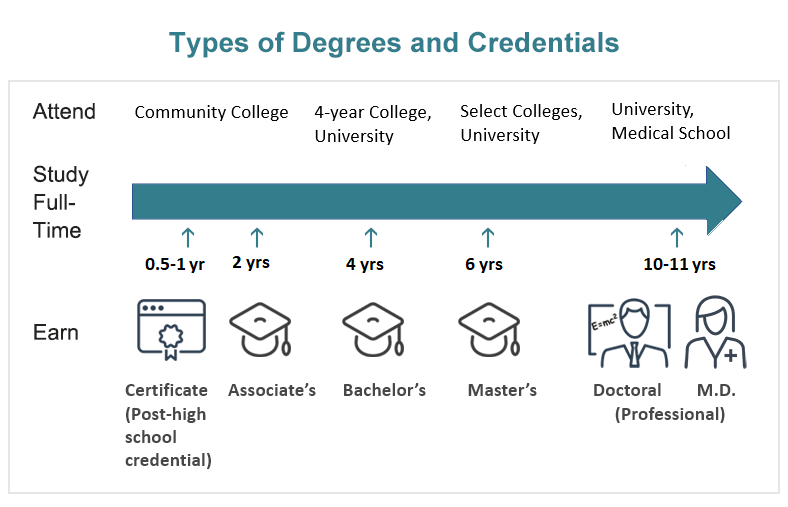
A bachelor's or master's degree in landscape architecture usually is necessary for entry into the profession. There are two undergraduate professional degrees: a Bachelor of Landscape Architecture (BLA) and a Bachelor of Science in Landscape Architecture (BSLA). These programs usually require four or five years of study for completion. Those who hold an undergraduate degree in a field other than landscape architecture can enroll in a Master of Landscape Architecture (MLA) graduate degree program, which typically takes three years of full-time study to complete. Those who hold undergraduate degrees in landscape architecture can earn their MLA in two years.
Courses required in these programs usually include subjects such as surveying, landscape design and construction, landscape ecology, site design, and urban and regional planning. Other courses include history of landscape architecture, plant and soil science, geology, professional practice, and general management. The design studio is a key component of any curriculum. Whenever possible, students are assigned real projects, providing them with valuable hands-on experience. While working on these projects, students become proficient in the use of computer-aided design, model building, geographic information systems, and video simulation.
Many employers recommend that prospective landscape architects complete a summer internship with a landscape architecture firm during their formal educational studies. Interns are able to hone their technical skills and gain an understanding of the day-to-day operations of the business, including how to win clients, generate fees, and work within a budget.
Companies That Hire Landscape Architects
Try it Out with an Activity or Project
STEM Activities
STEM activities are fun hands-on explorations that usually take from 10 minutes to one hour and use readily available household or classroom materials while introducing you to STEM concepts common in this career.
/-/https/www.sciencebuddies.org/cdn/Files/13340/5/flower-dissection-stem-activity-thumbnail.jpg)
/-/https/www.sciencebuddies.org/cdn/Files/16515/5/IrrigationSystem.jpg)
/-/https/www.sciencebuddies.org/cdn/Files/15947/5/SoilErosion.jpg)
Science Project Ideas
Project Ideas are in-depth STEM explorations that have a strong focus on controlling variables, taking accurate measurements, and analyzing data suitable for investigating the scientific method or the engineering design process.
/-/https/www.sciencebuddies.org/cdn/Files/7101/6/soil-erosion-thumbnail.jpg)
/-/https/www.sciencebuddies.org/Files/17865/10/rain-garden-overview-thumbnail.jpg)
/-/https/www.sciencebuddies.org/cdn/Files/12152/4/rooftop-garden-Chicago.jpg)
/-/https/www.sciencebuddies.org/cdn/Files/12243/4/flowers-nature-meadow.jpg)
/-/https/www.sciencebuddies.org/cdn/Files/3210/5/EnvEng_img029.jpg)
/-/https/www.sciencebuddies.org/cdn/Files/2882/3/CE_img041.gif)
/-/https/www.sciencebuddies.org/cdn/Files/12238/4/flower-casting-plant-watering.jpg)
/-/https/careerdiscovery.sciencebuddies.org/Dirs/37/0/img/thumbnail.png)
On the Job
Role Models

Nature of the Work
People enjoy attractively designed gardens, public parks and playgrounds, residential areas, college campuses, shopping centers, golf courses, and parkways. Landscape architects design these areas so they are not only functional but also beautiful and harmonious with the natural environment. They plan the location of buildings, roads, and walkways, along with the arrangement of flowers, shrubs, and trees. They also design and plan the restoration of natural places disturbed by humans, such as wetlands, stream corridors, mined areas, and forested land.
Working with building architects, surveyors, and engineers, landscape architects help determine the best arrangement of roads and buildings. They also collaborate with environmental scientists, foresters, and other professionals to find the best way to conserve or restore natural resources. Once these decisions are made, landscape architects create detailed plans indicating new topography, vegetation, walkways, and other landscaping details, such as fountains and decorative features.
In planning a site, landscape architects first consider the purpose of the project and the funds available. They then analyze the natural elements of the site, such as the climate, soil, slope of the land, drainage, and vegetation. They also assess existing buildings, roads, walkways, and utilities to determine what improvements are necessary. At all stages, they evaluate the project's impact on the local ecosystem.
After studying and analyzing the site, landscape architects prepare a preliminary design. To address the needs of the client, as well as the conditions at the site, they frequently make changes before a final design is approved. They also take into account any local, state, or federal regulations, such as those protecting wetlands or historic resources. In preparing designs, computer-aided design (or CAD) has become an essential tool for most landscape architects. Many landscape architects also use video simulation to help clients envision the proposed ideas and plans. For larger-scale site planning, landscape architects also use geographic information systems (GIS) technology, a computer mapping system.
Throughout all phases of planning and design, landscape architects consult with other professionals, such as civil engineers, hydrologists, or building architects, involved in the project. Once the design is complete, they prepare a proposal for the client. They produce detailed plans of the site, including written reports, sketches, models, photographs, land-use studies, and cost estimates, and then they submit them for approval by the client and by regulatory agencies. When the plans are approved, landscape architects prepare working drawings showing all existing and proposed features. They also outline in detail the methods of construction and draw up a list of necessary materials. Landscape architects then monitor the implementation of their design, while general contractors or landscape contractors usually direct the actual construction of the site and installation of plantings.
Some landscape architects work on a variety of projects. Others specialize in a particular area, such as street and highway beautification, waterfront improvement projects, parks and playgrounds, or shopping centers. Still others work in regional planning and resource management; feasibility, environmental impact, and cost studies; or site construction. Increasingly, landscape architects work in environmental remediation, such as preservation and restoration of wetlands or abatement of storm-water runoff in new developments. Historic landscape preservation and restoration is another area where landscape architects increasingly play a role.
Landscape architects who work for government agencies create site and landscape design for government buildings, parks, and other public lands, as well as park and recreation planning in national parks and forests. In addition, they may prepare environmental impact statements and studies on environmental issues such as public land-use planning.
Work Environment
Landscape architects spend most of their time in offices creating plans and designs, preparing models and cost estimates, doing research, or attending meetings with clients and other professionals involved in a design or planning project. The remainder of their time is spent at the site. During the design and planning stage, landscape architects visit and analyze the site to verify that the design can be incorporated into the landscape. After the plans and specifications are completed, they may spend additional time at the site observing or supervising the construction. Those who work in large national or regional firms can spend considerably more time out of the office traveling to sites.
Although many landscape architects work approximately 40 hours per week, many occasionally put in extra time at night or on weekends to meet deadlines.
More Information
Ask Questions
Do you have a specific question about a career as a Landscape Architect that isn't answered on this page? Post your question on the Science Buddies Ask an Expert Forum.
Additional Resources
If you would like additional information on this career, check out the following website:
Sources
- U.S. Bureau of Labor Statistics BLS (2024). Occupational Outlook Handbook (OOH), 2024 Edition, Bureau of Labor Statistics. Retrieved August 25, 2025.
- National Center for O*NET Development O*Net Online (2024). National Center for O*Net Development. Retrieved August 25, 2025
- National Aeronautics and Space Administration. (n.d.). Green Careers: Water-wise Landscaper. Retrieved June 24, 2019.
- Vogt, C. (2017, January 10). Issue Inc. Think BIG - the Indentity of City. An interview with Bruce A. Hendee. Retrieved June 24, 2019.