

Welder
Overview and Key Facts


Education

Median Pay

Job Growth

Jobs in 2034
What Do They Do?
A welder could...


Overview Listen to this section
What do race cars, bridges, boats, computers, bikes, and cell phones all have in common? They all require welding, or using tools to permanently bond pieces of metal together. Welders' skills are needed to assemble many of the objects you encounter and use every day. A career in welding could take you to the garage for a famous car race, to the tops of the highest buildings, or even to the bottom of the ocean!
Do You Have the Skills and Characteristics of a Welder?

Core Tasks
Think about if you'd like the typical tasks a Welder might do:Salary & Job Openings
Median Salary (Yearly Pay)
Future Jobs
Blast-Off:
(10% or higher)
(7% - 10%)
(5% - 7%)
(3% - 5%)
(0% - 3%)

Steps to Get There: Becoming a Welder
High School Subjects to Study
Engineering
Career Pathway Listen to this section
To become a welder, you need at least a high school diploma or a GED. Some students can take welding classes in high school or at a vocational school, then go straight into a welding job with on-the-job training. However, some employers may prefer to hire students who have postsecondary training in welding from a vocational or technical school. The American Welding Society offers additional certifications in general welding and specialty areas.Education- Typical Degree Needed After High School Listen to this section
high school credential
Typical degree for an entry-level position: High school diploma or equivalent ?
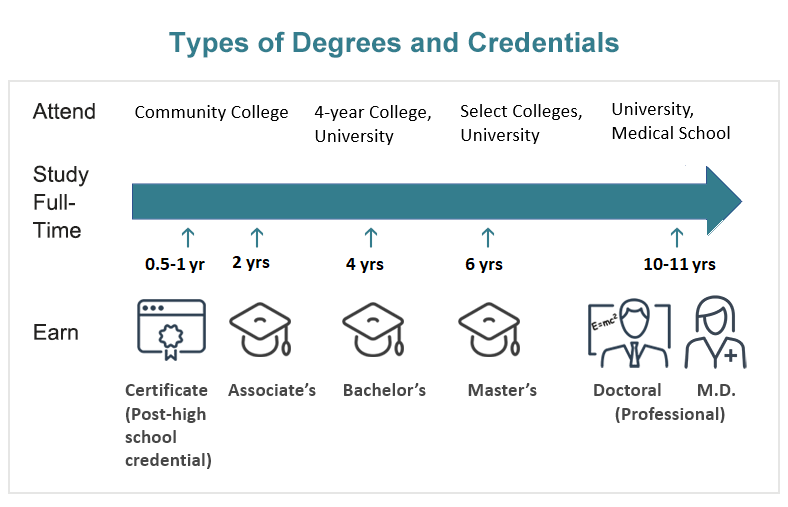
There are several ways for students to get exposure to welding while they are still in high school. Some high schools offer technical or shop classes with metalworking and welding lessons. Some school districts may allow students to transfer to a vocational or technical school where they can focus on welding. You may even be able to find a part-time or summer job that involves welding, like at an auto body shop or on a farm.
Some employers may be willing to hire welders straight out of high school, with additional on-the-job training to learn the skills they need for the job. However, many employers prefer to hire someone with additional postsecondary training in welding, which is available from vocational or technical schools, some community colleges, and private welding schools. Classes that help students understand the science behind welding (like physics and metallurgy), along with math skills (like algebra and geometry), are useful at both the high school and postsecondary levels.
Because welding careers can vary greatly, the type of training and experience necessary for a career will also vary, and some areas may require additional or specialty training. Welders working on cars will require different training and experience than those working on steel beams for high-rise buildings. A robotic welding technician will need computer programming skills to program a robotic arm to perform welds, and an underwater welder will also need to be a certified diver. The American Welding Society offers a range of certifications, from general Certified Welder to specialties like Certified Robotic Arc Welder and Senior Certified Welding Inspector, as well as classes and professional development seminars in different subjects like "Math for Welders" and "Safety in Welding." In general, if you are skilled or certified in more areas of welding, this will allow you to be more versatile and more attractive to an employer.
For students who are very interested in the science behind welding, there are also bachelor's and even graduate degree options available. Some engineering schools with materials science departments offer degrees in "welding and metallurgical engineering." Students who pursue advanced degrees may help research and develop new technologies and techniques that are used for welding.
Companies That Hire Welders
Try it Out with an Activity or Project
STEM Activities
STEM activities are fun hands-on explorations that usually take from 10 minutes to one hour and use readily available household or classroom materials while introducing you to STEM concepts common in this career.

Science Project Ideas
Project Ideas are in-depth STEM explorations that have a strong focus on controlling variables, taking accurate measurements, and analyzing data suitable for investigating the scientific method or the engineering design process.


On the Job
Role Models

Nature of the Work
Welders are skilled laborers who used specialized tools to permanently bond together pieces of metal. Welders are experts at the tools and techniques used to join pieces of metal together in a huge variety of situations and applications. Welders are involved in making many of the objects you use and see around you everyday, like cars, bikes, airplanes, boats, bridges, and buildings. They can even work on things that get launched into space, like satellites and parts for the International Space Station.
What a welder does on a day to day basis can vary immensely depending on the specific job. For example, a welder working in a factory may make the same repetitive welds to produce hundreds or thousands of the same car part. Increasingly, such repetitive tasks in factories are done by robots, but the robots still require a human technician to program, maintain, and operate them. A welder working in a repair shop for cars or construction equipment might see totally different jobs every day, depending on what vehicles come in and what needs to be repaired. A welder working on steel beams or pipes in the construction industry may spend several weeks or months at one job site, then move on to a completely new location once that building is completed. Another welder might make custom pieces of art or furniture based on requirements from individual customers.
The tools welders use every day can also vary depending on the job. "Arc welding" is the most common type of welding, which involves using a large amount of electrical current to generate heat and bond metals together. However, there are dozens of other tools and techniques used for welding. Which ones are used depends on the type of metals to be bonded and the specific situation. So, some welders may use the same tools most of the time, and others may encounter a wider variety of circumstances. Welders will be responsible for the maintenance and safe operation of the tools they use.
Welders are responsible for following blueprints, or designs, for projects, to make sure whatever they build matches the required dimensions and specifications. They are also responsible for following safety protocols, to protect both the workers and the people who will use the final product. This includes monitoring the welding process to ensure that the resulting welds meet acceptable standards. Certified welding inspectors may be responsible for inspecting other welders' work and checking the mechanical strength and integrity of welded joints. This is very important because a poor welding job can result in a catastrophe like structural collapse of a bridge or a building, so welders must take their jobs very seriously.
Work Environment
Because of the intense heat and light generated by welding, welders must wear special protective face masks and other gear, like heat-resistant gloves. This gear can be heavier and more uncomfortable than traditional "office" attire. Welders generally must work in well-ventilated areas because of the gases and fine particles that can be generated from welding.
The physical location where a welder works can vary depending on the job. Some welders always work indoors, such as in a factory or garage. Welders who work on outdoor construction projects may work in a variety of conditions, including inclement weather. Welders may be required to crouch or crawl into small spaces, work in cramped areas, or climb up tall structures. Specialized underwater welders will even work underwater while wearing full diving gear. This means that welders should be in good physical condition.
Most welders have a typical 40-hour work week, although overtime can be common. Some companies may have three 8-hour shifts or two 12-hour shifts per day so they can continue welding operations 24 hours per day.
More Information
Ask Questions
Do you have a specific question about a career as a Welder that isn't answered on this page? Post your question on the Science Buddies Ask an Expert Forum.
Additional Resources
Sources
- U.S. Bureau of Labor Statistics BLS (2024). Occupational Outlook Handbook (OOH), 2024 Edition, Bureau of Labor Statistics. Retrieved August 25, 2025.
- National Center for O*NET Development O*Net Online (2024). National Center for O*Net Development. Retrieved August 25, 2025
- Bureau of Labor Statistics, U.S. Department of Labor (2014, January 8). Occupational Outlook Handbook, 2014-15 Edition, Welders, Cutters, Solderers, and Brazers. Retrieved Sept. 16, 2015.
- Careers in Welding by AWS. (n.d.). Careers in Welding. Retrieved August 5, 2019.
- NEXT Network. (2011, October 21). Interview - Welder (Hayden Chandler) YouTube. Retrieved September 22, 2015.