
/-/https/careerdiscovery.sciencebuddies.org/cdn/Files/21464/5/sb-logo.png)
Medical & Clinical Laboratory Technician
Overview and Key Facts
/-/https/careerdiscovery.sciencebuddies.org/cdn/Files/1463/18/iStock-1156456853.jpg)

Education

Median Pay

Job Growth

Jobs in 2034
What Do They Do?
A medical or clinical laboratory technician could.../-/https/careerdiscovery.sciencebuddies.org/cdn/Files/1464/18/iStock-1136581010.jpg)
/-/https/careerdiscovery.sciencebuddies.org/cdn/Files/1465/18/pexels-photo-5726791.jpg)
/-/https/careerdiscovery.sciencebuddies.org/cdn/Files/1466/18/unsplash-Us3AQvyOP-o.jpg)
/-/https/careerdiscovery.sciencebuddies.org/cdn/Files/1467/18/pexels-photo-3985299.jpg)
/-/https/careerdiscovery.sciencebuddies.org/cdn/Files/1464/18/iStock-1136581010.jpg)
/-/https/careerdiscovery.sciencebuddies.org/cdn/Files/1465/18/pexels-photo-5726791.jpg)
/-/https/careerdiscovery.sciencebuddies.org/cdn/Files/1466/18/unsplash-Us3AQvyOP-o.jpg)
/-/https/careerdiscovery.sciencebuddies.org/cdn/Files/1467/18/pexels-photo-3985299.jpg)
Overview Listen to this section
Doctors need information to decide if a person is healthy or sick, if a baby's earache is bacterial or viral, or if the man next door needs medication to lower his cholesterol and prevent a heart attack. The information often comes in the form of results from lab tests. Medical and clinical laboratory technicians are the people who perform these routine medical laboratory tests, giving the doctors the information needed to diagnose, treat, and prevent disease./-/https/i.ytimg.com/vi/l6O189p1Tjg/sddefault.jpg)
Do You Have the Skills and Characteristics of a Medical & Clinical Laboratory Technician?

Core Tasks
Think about if you'd like the typical tasks a Medical & Clinical Laboratory Technician might do:Salary & Job Openings
Median Salary (Yearly Pay)
Future Jobs
Blast-Off:
(10% or higher)
(7% - 10%)
(5% - 7%)
(3% - 5%)
(0% - 3%)

Steps to Get There: Becoming a Medical & Clinical Laboratory Technician
High School Subjects to Study
Engineering
Career Pathway Listen to this section
Medical and clinical laboratory technicians generally have either an associate's degree from a community or junior college or a certificate from a hospital, vocational or technical school, or from one of the U.S. Armed Forces. A few technicians learn their skills on the job.
Certification is a voluntary process by which a nongovernmental organization, such as a professional society or certifying agency, grants recognition to an individual whose professional competence meets prescribed standards. For medical and laboratory technicians in the health industry, certification is a prerequisite for most jobs and often is necessary for advancement. Agencies certifying medical and clinical laboratory technologists and technicians include the Board of Registry of the American Society for Clinical Pathology, the American Medical Technologists, the National Credentialing Agency for Laboratory Personnel, and the Board of Registry of the American Association of Bioanalysts.
Some states also require laboratory personnel to be licensed or registered. Information on licensure is available from state departments of health or boards of occupational licensing.
Education- Typical Degree Needed After High School Listen to this section
high school credential
Typical degree for an entry-level position: Associate's degree ?
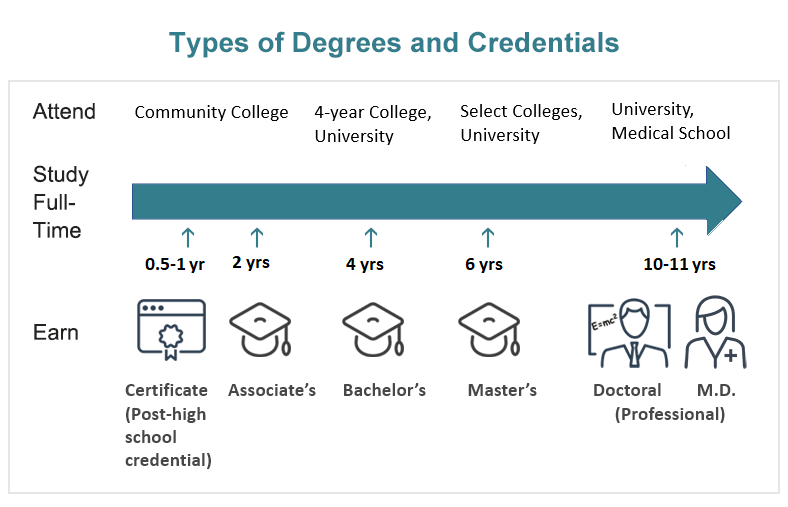
A career as a medical or clinical laboratory technician requires either an associate's degree from a community or junior college, or a certificate from a hospital, vocational, or technical school. Training can also be found in various branches of the U.S. Armed Forces.
Companies That Hire Medical & Clinical Laboratory Technicians
Try it Out with an Activity or Project
STEM Activities
STEM activities are fun hands-on explorations that usually take from 10 minutes to one hour and use readily available household or classroom materials while introducing you to STEM concepts common in this career.
/-/https/www.sciencebuddies.org/cdn/Files/15684/5/bacteria-art-agar-plates-thumbnail.jpg)
/-/https/www.sciencebuddies.org/cdn/Files/15634/6/virus-scale-thumbnail.jpg)
Science Project Ideas
Project Ideas are in-depth STEM explorations that have a strong focus on controlling variables, taking accurate measurements, and analyzing data suitable for investigating the scientific method or the engineering design process.
/-/https/www.sciencebuddies.org/cdn/Files/19911/5/gut-microbiome-and-antibiotics.jpg)
/-/https/www.sciencebuddies.org/cdn/Files/12803/5/Science-Buddies-Bacteria-Discovery-Kit.jpg)
/-/https/www.sciencebuddies.org/cdn/Files/4774/14/Immune-system-antibodies-bacteria_img.jpg)
/-/https/www.sciencebuddies.org/cdn/Files/3266/5/MicroBio_img025.jpg)
/-/https/www.sciencebuddies.org/cdn/Files/21585/4/blobid1759422335066.jpg)
/-/https/www.sciencebuddies.org/cdn/Files/2637/5/MicroBio_img018.jpg)
/-/https/www.sciencebuddies.org/cdn/Files/7087/5/BioChem_p008-thumbnail.jpg)
/-/https/www.sciencebuddies.org/cdn/Files/4299/5/Photo_img055.jpg)
/-/https/www.sciencebuddies.org/cdn/Files/4063/5/MicroBio_img033.jpg)
/-/https/www.sciencebuddies.org/cdn/Files/4692/6/streaking-plates_img.jpg)
/-/https/www.sciencebuddies.org/cdn/Files/4694/9/zone-of-inhibition_new_img.jpg)
/-/https/www.sciencebuddies.org/cdn/Files/6531/6/gel-banding-proteins.jpg)
/-/https/careerdiscovery.sciencebuddies.org/Dirs/37/0/img/thumbnail.png)
On the Job
Role Models

Nature of the Work
Clinical and medical laboratory personnel examine and analyze body fluids, and cells. They look for bacteria, parasites, and other microorganisms; analyze the chemical content of fluids; match blood for transfusions; and test for drug levels in blood, which show how a patient is responding to treatment. Technicians also prepare specimens for examination, count cells, and look for abnormal cells in blood and body fluids. They use microscopes, cell counters, and other sophisticated laboratory equipment. They also use automated equipment and computerized instruments capable of performing a number of tests simultaneously. After testing and examining a specimen, they analyze the results and relay them to physicians.
Work Environment
Working hours and other working conditions of clinical laboratory technologists and technicians vary, according to the size and type of employment setting. In large hospitals or in independent laboratories that operate continuously, personnel usually work the day, evening, or night shift and may work weekends and holidays.
Laboratory personnel in small facilities may work on rotating shifts, rather than on a regular shift. In some facilities, laboratory personnel are on-call several nights a week or on weekends, in case of an emergency. Clinical laboratory personnel must be thorough and accurate. They are trained to work with infectious specimens. When proper methods of infection control and sterilization are followed, few hazards exist. Protective masks, gloves, and goggles are often necessary to ensure the safety of laboratory personnel.
Laboratories usually are well-lit and clean; however, specimens, solutions, and reagents used in the laboratory sometimes produce fumes. Laboratory workers may spend a great deal of time on their feet.
More Information
Ask Questions
Do you have a specific question about a career as a Medical & Clinical Laboratory Technician that isn't answered on this page? Post your question on the Science Buddies Ask an Expert Forum.
Additional Resources
- Labs Are Vital
- American Society for Clinical Laboratory Science
- National Accrediting Agency for Clinical Laboratory Sciences
Sources
- U.S. Bureau of Labor Statistics BLS (2024). Occupational Outlook Handbook (OOH), 2024 Edition, Bureau of Labor Statistics. Retrieved August 25, 2025.
- National Center for O*NET Development O*Net Online (2024). National Center for O*Net Development. Retrieved August 25, 2025
- University of Michigan Transfusion Services Laboratory. (n.d.) Why I Became a Medical Technologist. Retrieved April 7, 2014.
- DrKitVideos, YouTube. (June 22, 2013). Medical Laboratory Technician, Career Video. Retrieved March 5, 2019.