
/-/https/careerdiscovery.sciencebuddies.org/cdn/Files/21464/5/sb-logo.png)
Optometrist
Overview and Key Facts
/-/https/careerdiscovery.sciencebuddies.org/cdn/Files/1570/17/iStock-930864180.jpg)

Education

Median Pay

Job Growth

Jobs in 2034
What Do They Do?
An optometrist could.../-/https/careerdiscovery.sciencebuddies.org/cdn/Files/1571/17/iStock-947299218.jpg)
/-/https/careerdiscovery.sciencebuddies.org/cdn/Files/1572/17/pexels-photo-261895.jpg)
/-/https/careerdiscovery.sciencebuddies.org/cdn/Files/1573/17/pexels-photo-5752281.jpg)
/-/https/careerdiscovery.sciencebuddies.org/cdn/Files/1574/17/pexels-photo-5752287.jpg)
/-/https/careerdiscovery.sciencebuddies.org/cdn/Files/1571/17/iStock-947299218.jpg)
/-/https/careerdiscovery.sciencebuddies.org/cdn/Files/1572/17/pexels-photo-261895.jpg)
/-/https/careerdiscovery.sciencebuddies.org/cdn/Files/1573/17/pexels-photo-5752281.jpg)
/-/https/careerdiscovery.sciencebuddies.org/cdn/Files/1574/17/pexels-photo-5752287.jpg)
Overview Listen to this section
Optometrists are the primary caretakers of our most important sense—vision. They diagnose and detect problems not only with vision, but with the health of the eye and the whole body. Based on their diagnoses, they prescribe glasses, contact lenses, and medications; refer patients to ophthalmologists for surgery; or develop treatment plans, like vision therapy, to help correct for deficits in depth perception. Their work helps people live better at every stage of life./-/https/i.ytimg.com/vi/FFn6H9FQYrs/hqdefault.jpg)
Do You Have the Skills and Characteristics of an Optometrist?

Core Tasks
Think about if you'd like the typical tasks an Optometrist might do:Salary & Job Openings
Median Salary (Yearly Pay)
Future Jobs
Blast-Off:
(10% or higher)
(7% - 10%)
(5% - 7%)
(3% - 5%)
(0% - 3%)

Steps to Get There: Becoming an Optometrist
High School Subjects to Study
Engineering
Career Pathway Listen to this section
The Doctor of Optometry degree requires the completion of a 4-year program at an accredited school of optometry, preceded by at least three years of pre-optometric study at an accredited college or university. All states require optometrists to be licensed.
Education- Typical Degree Needed After High School Listen to this section
high school credential
Typical degree for an entry-level position: Doctoral or professional degree ?
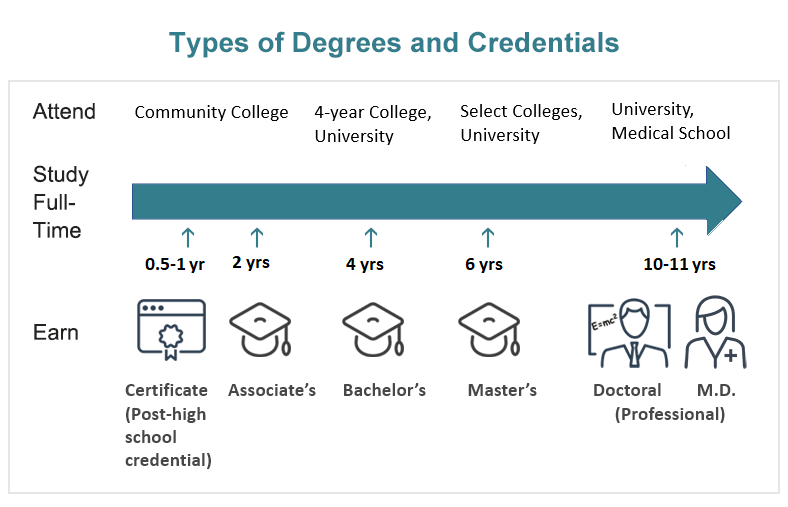
Optometrists need a Doctor of Optometry degree, which requires the completion of a 4-year program at an accredited school of optometry. In 2009, there were 19 colleges of optometry in the U.S. and one in Puerto Rico that offered programs accredited by the Accreditation Council on Optometric Education of the American Optometric Association. Requirements for admission to optometry schools include college courses in English, mathematics, physics, chemistry, and biology. Because a strong background in science is important, many applicants to optometry school major in a science, such as biology or chemistry, as undergraduates. Other applicants major in another subject and take many science courses offering laboratory experience.
Admission to optometry school is competitive; about 1 in 3 applicants was accepted in 2007. All applicants must take the Optometry Admissions Test (OAT), a standardized exam that measures academic ability and scientific comprehension. The OAT consists of four tests: survey of the natural sciences, such as biology, general chemistry, and organic chemistry; reading comprehension; physics; and quantitative reasoning. As a result, most applicants take the test after their sophomore or junior year in college, allowing them an opportunity to take the test again and raise their score. A few applicants are accepted to optometry school after three years of college and complete their bachelor's degree while attending optometry school. However, most students accepted by a school or college of optometry have completed an undergraduate degree. Each institution has its own undergraduate prerequisites, so applicants should contact the school or college of their choice for specific requirements.
Optometry programs include classroom and laboratory study of health and visual sciences, and clinical training in the diagnosis and treatment of eye disorders. Courses in pharmacology, optics, vision science, biochemistry, and systemic diseases are included.
One-year postgraduate clinical residency programs are available for optometrists who wish to obtain advanced clinical competence within a particular area of optometry. Specialty areas for residency programs include family practice optometry, pediatric optometry, geriatric optometry, vision therapy and rehabilitation, low-vision rehabilitation, cornea and contact lenses, refractive and ocular surgery, primary eye care optometry, and ocular disease.
Companies That Hire Optometrists
Try it Out with an Activity or Project
STEM Activities
STEM activities are fun hands-on explorations that usually take from 10 minutes to one hour and use readily available household or classroom materials while introducing you to STEM concepts common in this career.
/-/https/www.sciencebuddies.org/cdn/Files/14723/8/blue-green-red-color-overlap.png)
/-/https/www.sciencebuddies.org/cdn/Files/14375/5/blind-spot-covering-left-eye.jpg)
/-/https/www.sciencebuddies.org/cdn/Files/12939/7/water-drop-lens-on-letters-thumbnail.jpg)
/-/https/www.sciencebuddies.org/cdn/Files/12511/6/pupil-example-thumbnail.jpg)
/-/https/www.sciencebuddies.org/cdn/Files/16844/7/magnifying-discovery-thumbnail.jpg)
Science Project Ideas
Project Ideas are in-depth STEM explorations that have a strong focus on controlling variables, taking accurate measurements, and analyzing data suitable for investigating the scientific method or the engineering design process.
/-/https/www.sciencebuddies.org/cdn/Files/20639/6/blobid1721998920855.jpg)
/-/https/www.sciencebuddies.org/cdn/Files/3604/5/HumBio_img013.jpg)
/-/https/www.sciencebuddies.org/cdn/Files/2857/5/HumBeh_img019.gif)
/-/https/www.sciencebuddies.org/cdn/Files/12137/4/chromatic-adaptation-thumbnail.jpg)
/-/https/www.sciencebuddies.org/cdn/Files/2229/3/Astro_img004.gif)
/-/https/careerdiscovery.sciencebuddies.org/Dirs/37/0/img/thumbnail.png)
/-/https/www.sciencebuddies.org/cdn/Files/21737/5/person-868332_1280.jpg)
/-/https/www.sciencebuddies.org/cdn/Files/3605/5/HumBio_img017.jpg)
/-/https/www.sciencebuddies.org/cdn/Files/3524/5/HumBio_img006.jpg)
On the Job
Role Models

Nature of the Work
Optometrists, also known as doctors of optometry (or ODs), are the main providers of vision care. They examine people's eyes to diagnose vision problems, such as nearsightedness and farsightedness, and they test patients' depth and color perception and ability to focus and coordinate the eyes. Optometrists might prescribe eyeglasses or contact lenses, or they might provide other treatments, such as vision therapy or low-vision rehabilitation.
Optometrists also test for glaucoma and other eye diseases, and diagnose conditions caused by systemic diseases, such as diabetes and high blood pressure, referring patients to other health practitioners, as needed. They prescribe medication to treat vision problems or eye diseases, and some provide preoperative and postoperative care to cataract patients, as well as to patients who have had corrective laser surgery. Like other physicians, optometrists encourage preventative measures by promoting nutrition and hygiene education to their patients to minimize the risk of eye disease.
Although most work in a general practice as a primary care optometrist, some optometrists prefer to specialize in a particular field, such as contact lenses, geriatrics, pediatrics, or vision therapy. As a result, an increasing number of optometrists are forming group practices in which each group member specializes in a specific area, while still remaining a full-scope practitioner. For example, an expert in low-vision rehabilitation might help legally blind patients by custom-fitting them with a magnifying device that will enable them to read. Some might specialize in occupational vision, developing ways to protect workers' eyes from on-the-job strain or injury. Others might focus on sports vision, head trauma, or ocular disease and special testing. A few optometrists teach optometry, perform research, or consult.
Most optometrists are private practitioners who also handle the business aspects of running an office, such as developing a patient base, hiring employees, keeping paper and electronic records, and ordering equipment and supplies. Optometrists who operate franchise optical stores also might have some of these duties.
Optometrists should not be confused with ophthalmologists or dispensing opticians. Ophthalmologists are physicians who perform eye surgery, as well as diagnose and treat eye diseases and injuries. Like optometrists, they also examine eyes and prescribe eyeglasses and contact lenses. Dispensing opticians fit and adjust eyeglasses and, in some states, might fit contact lenses according to prescriptions written by ophthalmologists or optometrists.
Work Environment
Optometrists usually work in their own offices, which are clean, well-lit, and comfortable. Although most full-time optometrists work standard business hours, some work weekends and evenings to suit the needs of patients. Once uncommon, emergency calls have increased with the passage of therapeutic-drug laws expanding optometrists' ability to prescribe medications.
More Information
Ask Questions
Do you have a specific question about a career as an Optometrist that isn't answered on this page? Post your question on the Science Buddies Ask an Expert Forum.
Additional Resources
- American Optometric Association, Educational Services
- Association of Schools and Colleges of Optometry
Sources
- U.S. Bureau of Labor Statistics BLS (2024). Occupational Outlook Handbook (OOH), 2024 Edition, Bureau of Labor Statistics. Retrieved August 25, 2025.
- National Center for O*NET Development O*Net Online (2024). National Center for O*Net Development. Retrieved August 25, 2025
- Imagiverse. (2002, January 15). An Interview with Frank Terranova. Retrieved August 17, 2010.
- Vocational Schools. (2012). An Interview With Dr. Maria Higgins, Optometrist. Retrieved January 27, 2017.
- VisionaryEyecare. (2008, July 25). Optometrist vs. Ophthalmologist vs. Optician. Retrieved May 16, 2010.