
/-/https/careerdiscovery.sciencebuddies.org/cdn/Files/21464/5/sb-logo.png)
Physician Assistant
Overview and Key Facts
/-/https/careerdiscovery.sciencebuddies.org/cdn/Files/1634/17/unsplash-8WGHcMEAa2k.jpg)

Education

Median Pay

Job Growth

Jobs in 2034
What Do They Do?
A physicians assistant could.../-/https/careerdiscovery.sciencebuddies.org/cdn/Files/1635/17/pexels-photo-3133685.jpg)
/-/https/careerdiscovery.sciencebuddies.org/cdn/Files/1636/17/iStock-576893882.jpg)
/-/https/careerdiscovery.sciencebuddies.org/cdn/Files/1637/17/unsplash-CfdzNybONzc.jpg)
/-/https/careerdiscovery.sciencebuddies.org/cdn/Files/1638/17/unsplash-NMZdj2Zu36M.jpg)
/-/https/careerdiscovery.sciencebuddies.org/cdn/Files/1635/17/pexels-photo-3133685.jpg)
/-/https/careerdiscovery.sciencebuddies.org/cdn/Files/1636/17/iStock-576893882.jpg)
/-/https/careerdiscovery.sciencebuddies.org/cdn/Files/1637/17/unsplash-CfdzNybONzc.jpg)
/-/https/careerdiscovery.sciencebuddies.org/cdn/Files/1638/17/unsplash-NMZdj2Zu36M.jpg)
Overview Listen to this section
Would you like to sew up a bad cut after fall? Order and interpret X-rays? Help with surgery? Conduct physicals? Prescribe medications? Physician assistants have many of the same duties as physicians, only they practice medicine under the supervision of a physician or a surgeon. In rural or inner-city areas, physician assistants might have considerable independence, since they might be the only healthcare provider available to these communities. Physician assistants can choose to study specialties, too, just like physicians, and work in surgery, pediatrics, emergency medicine, orthopedics, or other health specialties./-/https/i.ytimg.com/vi/x3m-mmewRSo/sddefault.jpg)
Do You Have the Skills and Characteristics of a Physician Assistant?

Core Tasks
Think about if you'd like the typical tasks a Physician Assistant might do:Salary & Job Openings
Median Salary (Yearly Pay)
Future Jobs
Blast-Off:
(10% or higher)
(7% - 10%)
(5% - 7%)
(3% - 5%)
(0% - 3%)

Steps to Get There: Becoming a Physician Assistant
High School Subjects to Study
Engineering
Career Pathway Listen to this section
Requirements for admission to training programs vary; most applicants have a college degree and some health-related work experience. Commonly, nurses, EMTs, lab technicians, and paramedics apply to physician assistant programs. All states require physician assistants to complete an accredited, formal education program and pass a national exam to obtain a license.
Education- Typical Degree Needed After High School Listen to this section
high school credential
Typical degree for an entry-level position: Master's degree ?
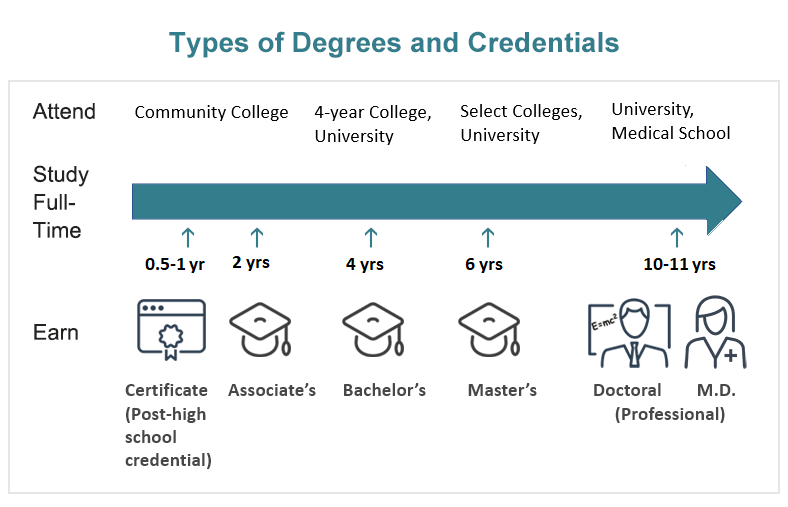
Physician assistant educational programs usually take at least 2 years to complete for full-time students. Most programs are at schools of allied health, academic health centers, medical schools, or 4-year colleges; a few are at community colleges, are part of the military, or are at hospitals. Many accredited PA programs have clinical teaching affiliations with medical schools.
In 2008, 142 education programs for physician assistants were accredited or provisionally accredited by the Accreditation Review Commission on Education for the Physician Assistant. Eighty percent, or 113, of these programs offered the option of a master's degree, 21 of them offered a bachelor's degree, three awarded associate degrees, and five awarded a certificate.
Most applicants to PA educational programs already have a college degree and some health-related work experience; however, admissions requirements vary from program to program. Many PAs have prior experience as registered nurses, emergency medical technicians, and paramedics.
PA education includes classroom and laboratory instruction in subjects like biochemistry, pathology, human anatomy, physiology, clinical pharmacology, clinical medicine, physical diagnosis, and medical ethics. PA programs also include supervised clinical training in several areas, including family medicine, internal medicine, surgery, prenatal care and gynecology, geriatrics, emergency medicine, and pediatrics. Sometimes, PA students serve in one or more of these areas under the supervision of a physician who is seeking to hire a PA. The rotation may lead to permanent employment in one of the areas where the student works.
Companies That Hire Physician Assistants
Try it Out with an Activity or Project
STEM Activities
STEM activities are fun hands-on explorations that usually take from 10 minutes to one hour and use readily available household or classroom materials while introducing you to STEM concepts common in this career.
/-/https/www.sciencebuddies.org/cdn/Files/13612/6/simple-lung-model-activity-thumbnail.jpg)
/-/https/www.sciencebuddies.org/cdn/Files/14690/6/lung-model-cough-up-mucus-thumbnail.jpg)
Science Project Ideas
Project Ideas are in-depth STEM explorations that have a strong focus on controlling variables, taking accurate measurements, and analyzing data suitable for investigating the scientific method or the engineering design process.
/-/https/www.sciencebuddies.org/cdn/Files/9024/9/exercise-respirator-bottle-green.jpg)
/-/https/careerdiscovery.sciencebuddies.org/Dirs/37/0/img/thumbnail.png)
/-/https/www.sciencebuddies.org/cdn/Files/2910/10/Sports_img053.jpg)
/-/https/www.sciencebuddies.org/cdn/Files/20910/7/blobid1730742135699.jpg)
/-/https/www.sciencebuddies.org/cdn/Files/3597/5/HumBio_img011.jpg)
/-/https/www.sciencebuddies.org/cdn/Files/3456/10/MamBio_img009.jpg)
/-/https/www.sciencebuddies.org/cdn/Files/20817/6/blobid1727383248205.jpg)
On the Job
Role Models

Nature of the Work
Physician assistants (PAs) practice medicine under the supervision of physicians and surgeons. They should not be confused with medical assistants, who perform routine clinical and clerical tasks. PAs are formally trained to provide diagnostic, therapeutic, and preventive healthcare services, as delegated by a physician. Working as members of a healthcare team, they take medical histories, examine and treat patients, order and interpret laboratory tests and X-rays, and make diagnoses. They also treat minor injuries by suturing, splinting, and casting. PAs record progress notes, instruct and counsel patients, and order or carry out therapy. Physician assistants also may prescribe certain medications. In some establishments, a PA is responsible for managerial duties, such as ordering medical supplies or equipment and supervising medical technicians and assistants.
Physician assistants work under the supervision of a physician. However, PAs may be the principal care providers in rural or inner-city clinics where a physician is present for only 1 or 2 days each week. In such cases, the PA confers with the supervising physician and other medical professionals as needed and as required by law. PAs also may make house calls or go to hospitals and nursing care facilities to check on patients, after which they report back to the physician.
The duties of physician assistants are determined by the supervising physician and by state law. Aspiring PAs should investigate the laws and regulations in the states in which they wish to practice.
Many PAs work in primary care specialties, such as general internal medicine, pediatrics, and family medicine. Other specialty areas include general and thoracic surgery, emergency medicine, orthopedics, and geriatrics. PAs specializing in surgery provide preoperative and postoperative care and may work as first or second assistants during major surgery.
Work Environment
Although PAs usually work in a comfortable, well-lit environment, those in surgery often stand for long periods. At times, the job requires a considerable amount of walking.
PA's work schedules may vary according to the practice setting and often depend on the hours of the supervising physician. The workweek of hospital-based PAs may include weekends, nights, or early morning hospital rounds to visit patients. These workers also may be on call. PAs in clinics usually work about a 40-hour week.
More Information
Ask Questions
Do you have a specific question about a career as a Physician Assistant that isn't answered on this page? Post your question on the Science Buddies Ask an Expert Forum.
Additional Resources
- Accreditation Review Commission on Education for the Physician Assistants
- American Academy of Physician Assistants Information Center
- National Commission on Certification of Physician Assistants, Inc.
Sources
- U.S. Bureau of Labor Statistics BLS (2024). Occupational Outlook Handbook (OOH), 2024 Edition, Bureau of Labor Statistics. Retrieved August 25, 2025.
- National Center for O*NET Development O*Net Online (2024). National Center for O*Net Development. Retrieved August 25, 2025
- EmpoweredPAs.com. (2019, April 23). A Day in the Life of a PA Interview Series. Retrieved May 22, 2019.
- PennCollegeVideos. (2009, November 23). Physician Assistant with Jennifer Fritz. Retrieved May 13, 2010.