
/-/https/careerdiscovery.sciencebuddies.org/Files/21464/5/sb-logo.png)
Psychologist
Overview and Key Facts
/-/https/careerdiscovery.sciencebuddies.org/Files/1698/17/pexels-photo-5699469.jpg)

Education

Median Pay

Job Growth

Jobs in 2034
What Do They Do?
A psychologist could.../-/https/careerdiscovery.sciencebuddies.org/Files/1699/18/pexels-photo-163487.jpg)
/-/https/careerdiscovery.sciencebuddies.org/Files/1700/17/iStock-927889590.jpg)
/-/https/careerdiscovery.sciencebuddies.org/Files/1701/17/iStock-1208819264.jpg)
/-/https/careerdiscovery.sciencebuddies.org/Files/1702/17/pexels-photo-3992949.jpg)
/-/https/careerdiscovery.sciencebuddies.org/Files/1699/18/pexels-photo-163487.jpg)
/-/https/careerdiscovery.sciencebuddies.org/Files/1700/17/iStock-927889590.jpg)
/-/https/careerdiscovery.sciencebuddies.org/Files/1701/17/iStock-1208819264.jpg)
/-/https/careerdiscovery.sciencebuddies.org/Files/1702/17/pexels-photo-3992949.jpg)
Overview Listen to this section
Why people take certain actions can often feel like a mystery. Psychologists help solve these mysteries by investigating the physical, cognitive, emotional, or social aspects of human behavior and the human mind. Some psychologists also apply these findings in order to design better products or to help people change their behaviors./-/https/i.ytimg.com/vi/ESmZAJn_hyY/maxresdefault.jpg)
Do You Have the Skills and Characteristics of a Psychologist?

Core Tasks
Think about if you'd like the typical tasks a Psychologist might do:Salary & Job Openings
Median Salary (Yearly Pay)
Future Jobs
Blast-Off:
(10% or higher)
(7% - 10%)
(5% - 7%)
(3% - 5%)
(0% - 3%)

Steps to Get There: Becoming a Psychologist
High School Subjects to Study
Engineering
Career Pathway Listen to this section
A master's or doctoral degree, and a license, are required for most psychologists. One exception is the working for the federal government, where candidates with at least 24 semester hours in psychology and one course in statistics qualify for entry-level positions. However, competition for these jobs is keen because this is one of the few ways in which one can work as a psychologist without an advanced degree.
People with a master's degree in psychology may work as industrial-organizational psychologists. They also may work as psychological assistants under the supervision of doctoral-level psychologists and may conduct research or psychological evaluations.
A doctoral degree usually is required for independent practice as a psychologist. Psychologists with a PhD or Doctor of Psychology (Psy.) qualify for a wide range of teaching, research, clinical, and counseling positions in universities, healthcare services, elementary and secondary schools, private industry, and government. Psychologists with a doctoral degree often work in clinical positions or in private practices, but they also sometimes teach, conduct research, or carry out administrative responsibilities.
In addition to educational requirements, psychologists in independent practice or those who offer any type of patient care—including clinical, counseling, and school psychologists—must meet certification or licensing requirements. Licensing laws vary by state and by type of position, and require licensed or certified psychologists to limit their practice to areas in which they have developed professional competence through training and experience. Most state licensing boards administer a standardized test, and many supplement that with additional oral or essay questions. Some states require continuing education for renewal of the license.
Education- Typical Degree Needed After High School Listen to this section
high school credential
Typical degree for an entry-level position: Doctoral or professional degree ?
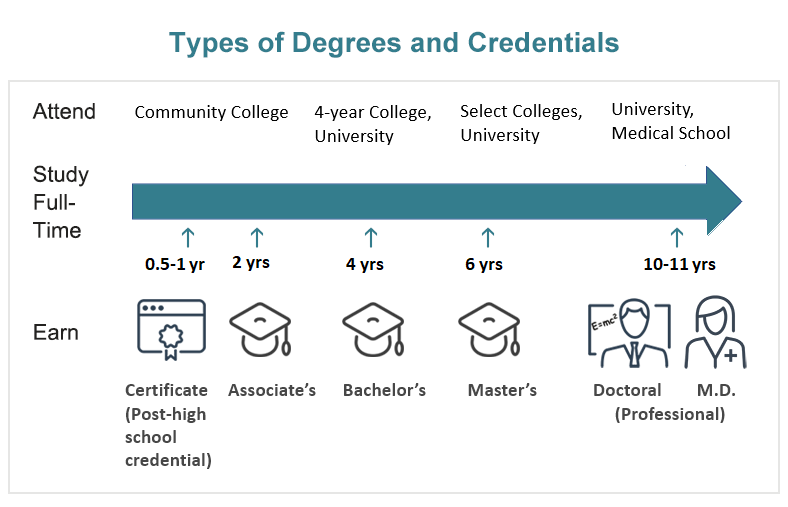
A master's or doctoral degree is required for most psychologists. Competition for admission to graduate psychology programs is keen. Some universities require applicants to have an undergraduate major in psychology. Others prefer only coursework in basic psychology, with additional courses in the biological, physical, and social sciences, and in statistics and mathematics.
A master's degree in psychology requires at least 2 years of full-time graduate study. Requirements usually include practical experience in an applied setting and a master's thesis based on an original research project. A doctoral degree takes longer, requiring 5-7 years of graduate study, culminating in a dissertation based on original research. Courses in quantitative research methods, which include the use of computer-based analysis, are an integral part of graduate study and are necessary to complete the dissertation. The PsyD degree may be based on practical work and examinations, rather than on a dissertation. In clinical, counseling, and school psychology, the requirements for the doctoral degree include at least a 1-year internship.
Companies That Hire Psychologists
Try it Out with an Activity or Project
STEM Activities
STEM activities are fun hands-on explorations that usually take from 10 minutes to one hour and use readily available household or classroom materials while introducing you to STEM concepts common in this career.
/-/https/www.sciencebuddies.org/Files/6074/6/left-right-handedness-dominance.jpg)
/-/https/www.sciencebuddies.org/Files/14723/8/blue-green-red-color-overlap.png)
/-/https/www.sciencebuddies.org/Files/13098/5/color-taste-test-thumbnail.jpg)
/-/https/www.sciencebuddies.org/Files/5837/7/Bouba-sounds-language.jpg)
/-/https/www.sciencebuddies.org/Files/15891/5/LieDetector.jpg)
Science Project Ideas
Project Ideas are in-depth STEM explorations that have a strong focus on controlling variables, taking accurate measurements, and analyzing data suitable for investigating the scientific method or the engineering design process.
/-/https/www.sciencebuddies.org/Files/20674/6/blobid1722457840063.jpg)
/-/https/www.sciencebuddies.org/Files/6727/9/stroop-effect-cards.jpg)
/-/https/www.sciencebuddies.org/Files/20924/6/blobid1732545991548.jpg)
/-/https/www.sciencebuddies.org/Files/21377/4/blobid1754328829475.jpg)
/-/https/careerdiscovery.sciencebuddies.org/Dirs/37/0/img/thumbnail.png)
/-/https/www.sciencebuddies.org/Files/20278/8/courtroom.jpg)
/-/https/www.sciencebuddies.org/Files/20286/8/notebook-phone-computer.jpg)
/-/https/www.sciencebuddies.org/Files/20440/6/blobid0.jpg)
/-/https/www.sciencebuddies.org/Files/4066/13/HumBeh_img050.jpg)
/-/https/www.sciencebuddies.org/Files/3074/12/visual-side.jpg)
/-/https/www.sciencebuddies.org/Files/20337/7/blobid1712842133382.png)
/-/https/www.sciencebuddies.org/Files/5835/11/Bouba-Kiki-effect-shapes.jpg)
/-/https/www.sciencebuddies.org/Files/6966/5/animated-3Dboy.jpg)
/-/https/www.sciencebuddies.org/Files/4031/8/HumBeh_img047.jpg)
/-/https/www.sciencebuddies.org/Files/20230/13/woman-on-phone.jpg)
/-/https/www.sciencebuddies.org/Files/3000/3/HumBeh_img020.jpg)
/-/https/www.sciencebuddies.org/Files/6576/6/string-instruments-orchestra.jpg)
/-/https/www.sciencebuddies.org/Files/3974/5/HumBeh_img045.jpg)
/-/https/www.sciencebuddies.org/Files/12137/4/chromatic-adaptation-thumbnail.jpg)
On the Job
Role Models

Nature of the Work
Psychologists study the human mind and human behavior. Research psychologists investigate the physical, cognitive, emotional, or social aspects of human behavior; while psychologists in health service fields provide mental health care in hospitals, clinics, schools, or private settings. Psychologists employed in applied settings, such as business, industry, government, or nonprofit organizations, provide training, conduct research, design organizational systems, and act as advocates for psychology.
Like other social scientists, psychologists formulate hypotheses and collect data to test their validity. Research methods vary with the topic under study. Psychologists sometimes gather information through controlled laboratory experiments or by administering personality, performance, aptitude, or intelligence tests. Other methods include observation, interviews, questionnaires, clinical studies, and surveys.
Within the field of psychology there are a number of specialties that lead to different careers. These specialties include the following:
- Clinical psychologists, who constitute the largest specialty, work most often in counseling centers, independent or group practices, hospitals, or clinics. They help mentally and emotionally distressed clients adjust to life and may assist medical and surgical patients in dealing with illnesses or injuries.
- Counseling psychologists use various techniques, including interviewing and testing, to advise people on how to deal with problems of everyday living, including career or work problems and problems faced in different stages of life. They work in settings such as university counseling centers, hospitals, and individual or group practices.
- School psychologists work with students in early childhood and elementary and secondary schools. They collaborate with teachers, parents, and school personnel to create safe, healthy, and supportive learning environments for all students. School psychologists address students' learning and behavioral problems, suggest improvements to classroom-management strategies or parenting techniques, and evaluate students with disabilities and gifted and talented students to help determine the best way to educate them.
- Industrial-organizational psychologists apply psychological principles and research methods to the workplace in the interest of improving productivity and the quality of work life. They also are involved in research on management and marketing problems. An industrial psychologist might work with management to reorganize the work setting in order to improve productivity or quality of life in the workplace. Industrial psychologists frequently act as consultants, brought in by management to solve a particular problem.
- Developmental psychologists study the physiological, cognitive, and social development that takes place throughout life. Some specialize in behavior during infancy, childhood, and adolescence, or in changes that occur during maturity or old age.
- Social psychologists examine people's interactions with others and with the social environment. They work in organizational consultation, marketing research, systems design, or other applied psychology fields. Prominent areas of study include group behavior, leadership, attitudes, and perception.
- Experimental or research psychologists work in university and private research centers and in business, nonprofit, and governmental organizations. They study the behavior of both human beings and animals, such as rats, monkeys, and pigeons. Prominent areas of study in experimental research include motivation, thought, attention, learning and memory, sensory and perceptual processes, effects of substance abuse, and genetic and neurological factors affecting behavior.
Work Environment
Psychologists' work environments vary by sub-field and by place of employment. For example, clinical, school, and counseling psychologists who are in private practice, frequently have their own offices and set their own hours. However, they usually offer evening and weekend hours to accommodate their clients. Those employed in hospitals, nursing homes, and other healthcare facilities may work shifts that include evenings and weekends, and those who work in schools and clinics generally work regular daytime hours. Most psychologists in government and industry have structured schedules.
Psychologists employed as faculty by colleges and universities divide their time between teaching and research and also may have administrative responsibilities; many have part-time consulting practices.
Increasingly, many psychologists work as part of a team, consulting with other psychologists and professionals. Many experience pressures because of deadlines, tight schedules, and overtime. Their routine may be interrupted frequently. Travel may be required in order to attend conferences or to conduct research.
More Information
Ask Questions
Do you have a specific question about a career as a Psychologist that isn't answered on this page? Post your question on the Science Buddies Ask an Expert Forum.
Sources
- U.S. Bureau of Labor Statistics BLS (2024). Occupational Outlook Handbook (OOH), 2024 Edition, Bureau of Labor Statistics. Retrieved August 25, 2025.
- National Center for O*NET Development O*Net Online (2024). National Center for O*Net Development. Retrieved August 25, 2025
- American Psychological Association. (2019). Interesting Careers in Psychological Science. Retrieved March 21, 2019.
- Michigan State University, YouTube. (2019, February 20). MSU Social Scientist's Research to help NASA's Future Missions to Mars. Retrieved March 21, 2019.