
/-/https/careerdiscovery.sciencebuddies.org/Files/21464/5/sb-logo.png)
Data Scientist
Overview and Key Facts
/-/https/careerdiscovery.sciencebuddies.org/Files/17070/11/pexels-photo-5716042.jpg)

Education

Median Pay

Job Growth

Jobs in 2034
What Do They Do?
A data scientist could.../-/https/careerdiscovery.sciencebuddies.org/Files/1014/19/pexels-photo-3977908.jpg)
/-/https/careerdiscovery.sciencebuddies.org/Files/6189/12/pexels-photo-264300.jpg)
/-/https/careerdiscovery.sciencebuddies.org/Files/20220/5/data-scientist-distillation.jpg)
/-/https/careerdiscovery.sciencebuddies.org/Files/6193/10/iStock-1176398463.jpg)
/-/https/careerdiscovery.sciencebuddies.org/Files/1014/19/pexels-photo-3977908.jpg)
/-/https/careerdiscovery.sciencebuddies.org/Files/6189/12/pexels-photo-264300.jpg)
/-/https/careerdiscovery.sciencebuddies.org/Files/20220/5/data-scientist-distillation.jpg)
/-/https/careerdiscovery.sciencebuddies.org/Files/6193/10/iStock-1176398463.jpg)
Overview Listen to this section
Many aspects of peoples' daily lives can be summarized using data, from what is the most popular new video game to where people like to go for a summer vacation. Data scientists (sometimes called data analysts) are experts at organizing and analyzing large sets of data (often called "big data"). By doing this, data scientists make conclusions that help other people or companies. For example, data scientists could help a video game company make a more profitable video game based on players' online behaviors, or help a travel agency figure out what destinations they should make vacation packages for./-/https/i.ytimg.com/vi/_Wk9T_G-u4o/sddefault.jpg)
Do You Have the Skills and Characteristics of a Data Scientist?

Core Tasks
Think about if you'd like the typical tasks a Data Scientist might do:Salary & Job Openings
Median Salary (Yearly Pay)
Future Jobs
Blast-Off:
(10% or higher)
(7% - 10%)
(5% - 7%)
(3% - 5%)
(0% - 3%)

Steps to Get There: Becoming a Data Scientist
High School Subjects to Study
Engineering
Career Pathway Listen to this section
To become a data scientist, a person usually starts out with a bachelor's degree in one of many possible fields, and then specializes as a data scientist through experience and/or additional degrees. While a bachelor's degree is the minimum requirement, many companies prefer or require data scientists who have more advanced degrees, specifically a master's degree or a PhD. Skilled workers who keep up-to-date with the latest technology usually have the best opportunities.
Education- Typical Degree Needed After High School Listen to this section
high school credential
Typical degree for an entry-level position: Bachelor's degree ?
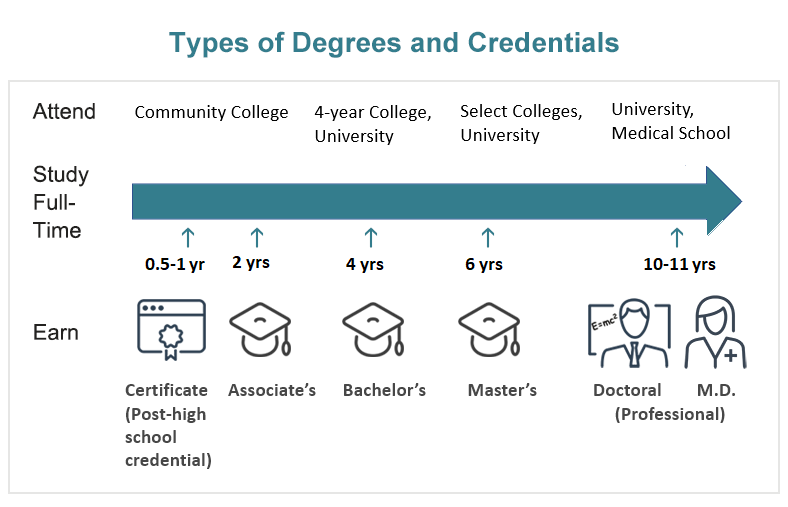
Data scientists must have at least a bachelor's degree with a major that is typically in one of the following areas or a related area: computer science, mathematics (e.g., applied math, data analytics, or statistics), physics, or biology (e.g., genetics). Some data scientists major in economics or behavioral sciences (e.g., psychology or sociology) instead, depending on the type of data they deal with.
In addition to having a relevant bachelor's degree, many employers also want a data scientist who has a master's degree or a PhD in a relevant field, or an equivalent number of years of experience. For example, an employer may look for a data scientist with a master's degree or a PhD in a field related to statistics or data-based research, or a data scientist with a bachelor's degree and 3-5 years of professional work experience in a related area. (Professional work experience can also be gained by doing an internship with a company.)
The type of educational background a data scientist has depends on what type of data they want to analyze in their career. For example, if a data scientist wants to work with a company that develops video games to try to improve the gaming experience, it may help if they have a degree in psychology, sociology, and/or computer science. Alternatively, if a data scientist wants to work with a healthcare provider to analyze what type of healthcare coverage should be made available to their clients, a background in a biology- and/or economics-related field may be more appropriate.
No matter what specific degree(s) a data scientist has, it is also important to have an educational background that includes statistics (and preferably other mathematics courses) and computer experience. Specifically, to organize and analyze large sets of data and entire databases, experience with using relevant computer programs and having some basic computer programming skills is highly desirable.
Try it Out with an Activity or Project
STEM Activities
STEM activities are fun hands-on explorations that usually take from 10 minutes to one hour and use readily available household or classroom materials while introducing you to STEM concepts common in this career.
/-/https/www.sciencebuddies.org/cdn/Files/14495/5/scratch-covid-19-simulator.jpg)
/-/https/www.sciencebuddies.org/cdn/Files/15558/6/domino-setup-23-immune-thumbnail.jpg)
Science Project Ideas
Project Ideas are in-depth STEM explorations that have a strong focus on controlling variables, taking accurate measurements, and analyzing data suitable for investigating the scientific method or the engineering design process.
/-/https/www.sciencebuddies.org/cdn/Files/19899/9/walking-tiger-ai-thumbnail.jpg)
/-/https/www.sciencebuddies.org/Files/21255/4/blobid1749490921240.png)
/-/https/www.sciencebuddies.org/cdn/Files/19305/8/artificial-intelligence-main.jpg)
/-/https/www.sciencebuddies.org/cdn/Files/12111/12/dna-helix-protein-thumbnail.jpg)
/-/https/www.sciencebuddies.org/cdn/Files/7406/7/M80-globular-cluster.jpg)
/-/https/www.sciencebuddies.org/cdn/Files/19911/5/gut-microbiome-and-antibiotics.jpg)
/-/https/www.sciencebuddies.org/cdn/Files/6427/12/tidal-bulge.jpg)
/-/https/www.sciencebuddies.org/Files/22081/4/blobid1786298093170.jpg)
/-/https/www.sciencebuddies.org/Files/20929/6/blobid1733171985371.jpg)
/-/https/www.sciencebuddies.org/Files/21377/4/blobid1754328829475.jpg)
/-/https/www.sciencebuddies.org/Files/20996/6/blobid1738087269760.jpg)
/-/https/www.sciencebuddies.org/cdn/Files/19120/4/cyclone-pic0.jpg)
/-/https/www.sciencebuddies.org/cdn/Files/19873/8/breast-cancer-AI.jpg)
/-/https/www.sciencebuddies.org/cdn/Files/3728/10/Astro_img103.jpg)
/-/https/www.sciencebuddies.org/Files/12090/9/nasa-asteroid-thumbnail.jpg)
/-/https/www.sciencebuddies.org/cdn/Files/18383/5/road-sign-thumbnail.jpg)
/-/https/www.sciencebuddies.org/cdn/Files/6894/6/social-media-thumbnail.jpg)
/-/https/www.sciencebuddies.org/cdn/Files/3607/5/Genom_img074.jpg)
/-/https/www.sciencebuddies.org/cdn/Files/12236/9/geese-birds-flock-flying.jpg)
/-/https/www.sciencebuddies.org/Files/20643/6/blobid0.jpg)
On the Job
Role Models

Nature of the Work
Data scientists, who are also sometimes called data analysts, are experts at organizing, analyzing, and drawing conclusions from large sets of data. They do this by using computer programs and applying their knowledge of mathematics and algorithms (which are step-by-step procedures used for making a calculation).
The conclusions that data scientists come to from analyzing the data help other people and companies improve their product (such as a vacation package) or solve a problem (such as fixing gameplay in a video game). Depending on the exact field that the data scientist is working in, the data scientist may also need to apply their knowledge of computer science, physics, biology, economics, or a behavioral science to do their job.
When an employer turns to a data scientist for help, they typically have a specific goal in mind or a question they want answered. For example, a healthcare provider may want to know what type of healthcare coverage should be offered to their clients, and what costs are reasonable for covering different medical procedures and medications. To figure this out, a data scientist will use computer programs to go through databases of relevant information. During this process, the data scientist might develop an algorithm (or even their own computer program) to do some of the work for them automatically so they do not have to go through all of the data manually.
Once the data scientist has drawn some large-scale conclusions based on the data they sorted and analyzed, they need a way to easily present their results to other people. Because of this, some data scientists need to be able to use computer programs that make visualizations (i.e., detailed graphs) based on data. Data scientists may also need to prepare written reports and presentations to groups of people (such as co-workers, collaborators, and potential clients), many of whom are non-technical personnel, so it is important for data scientists to be able to communicate well.
Overall, the conclusions that the data scientists come to based on analyzing all of the data goes into helping a company make a better product or offer better services.
Work Environment
Data scientists spend the majority of their time in front of a computer, and work in clean, comfortable offices. Most data scientists work about 40 hours per week, but sometimes they may work more hours to meet deadlines.
Some data scientists travel to provide advice on projects, supervise and set up surveys, or gather statistical data. While email and teleconferencing are making it easier for data scientists to work with clients in different locations, there still are situations that require the data scientist to be present, such as during certain meetings or while gathering data.
Like other workers who spend long periods of time in front of a computer typing at a keyboard, data scientists are susceptible to eye strain, back discomfort, and hand and wrist problems, such as carpal tunnel syndrome.
More Information
Ask Questions
Do you have a specific question about a career as a Data Scientist that isn't answered on this page? Post your question on the Science Buddies Ask an Expert Forum.
Additional Resources
Sources
- U.S. Bureau of Labor Statistics BLS (2024). Occupational Outlook Handbook (OOH), 2024 Edition, Bureau of Labor Statistics. Retrieved August 25, 2025.
- National Center for O*NET Development O*Net Online (2024). National Center for O*Net Development. Retrieved August 25, 2025
- Gualtieri, M. (2013, June 4). What is a Data Scientist? Forrester. Retrieved July 7, 2014.
- Lo, F. (n.d.). Big Data Salaries: An Inside Look DataJobs. Retrieved July 7, 2014.
- Chevron, YouTube. (2018, February 12). Day in the Life: Data Scientist. Retrieved April 12, 2019.
- The Wall Street Journal. (2013, December 11). Interview with Data Analyst at Game Operator DeNA. Retrieved April 12, 2019.
- Patel, M. (2012, April 23). Big Data Transforms Business: A Data Scientist Speaks EMC. Retrieved April 12, 2019.