
/-/https/careerdiscovery.sciencebuddies.org/cdn/Files/21464/5/sb-logo.png)
Math Teacher
Overview and Key Facts
/-/https/careerdiscovery.sciencebuddies.org/cdn/Files/1436/17/pexels-photo-5905484.jpg)

Education

Median Pay

Job Growth

Jobs in 2034
What Do They Do?
A math teacher could.../-/https/careerdiscovery.sciencebuddies.org/cdn/Files/1437/17/pexels-photo-5915236.jpg)
/-/https/careerdiscovery.sciencebuddies.org/cdn/Files/1438/17/iStock-481625182.jpg)
/-/https/careerdiscovery.sciencebuddies.org/cdn/Files/1439/17/pexels-photo-5212345.jpg)
/-/https/careerdiscovery.sciencebuddies.org/cdn/Files/1440/17/pexels-photo-5637769.jpg)
/-/https/careerdiscovery.sciencebuddies.org/cdn/Files/1437/17/pexels-photo-5915236.jpg)
/-/https/careerdiscovery.sciencebuddies.org/cdn/Files/1438/17/iStock-481625182.jpg)
/-/https/careerdiscovery.sciencebuddies.org/cdn/Files/1439/17/pexels-photo-5212345.jpg)
/-/https/careerdiscovery.sciencebuddies.org/cdn/Files/1440/17/pexels-photo-5637769.jpg)
Overview Listen to this section
Math teachers love mathematics and understand it well, but much more than that, they enjoy sharing their enthusiasm for the language of numbers with students. They use a variety of tools and techniques to help students grasp abstract concepts and show them that math describes the world around them. By helping students conquer fears and anxieties about math, teachers can open up many science and technology career possibilities for students. Teachers make a difference that lasts a lifetime!/-/https/i.ytimg.com/vi/YwVcYGpgRSA/maxresdefault.jpg)
Do You Have the Skills and Characteristics of a Math Teacher?

Core Tasks
Think about if you'd like the typical tasks a Math Teacher might do:Salary & Job Openings
Median Salary (Yearly Pay)
Future Jobs
Blast-Off:
(10% or higher)
(7% - 10%)
(5% - 7%)
(3% - 5%)
(0% - 3%)

Steps to Get There: Becoming a Math Teacher
High School Subjects to Study
Engineering
Career Pathway Listen to this section
The traditional route to becoming a public school teacher involves completing a bachelor's degree from a teacher education program and then obtaining a license. However, most states now offer alternative routes to licensure for those who have a college degree in other fields. Private school teachers do not have to be licensed, but still need a bachelor's degree. A bachelor's degree may not be needed by preschool teachers and vocational education teachers, who need experience in their field rather than a specific degree.
Education- Typical Degree Needed After High School Listen to this section
high school credential
Typical degree for an entry-level position: Bachelor's degree ?
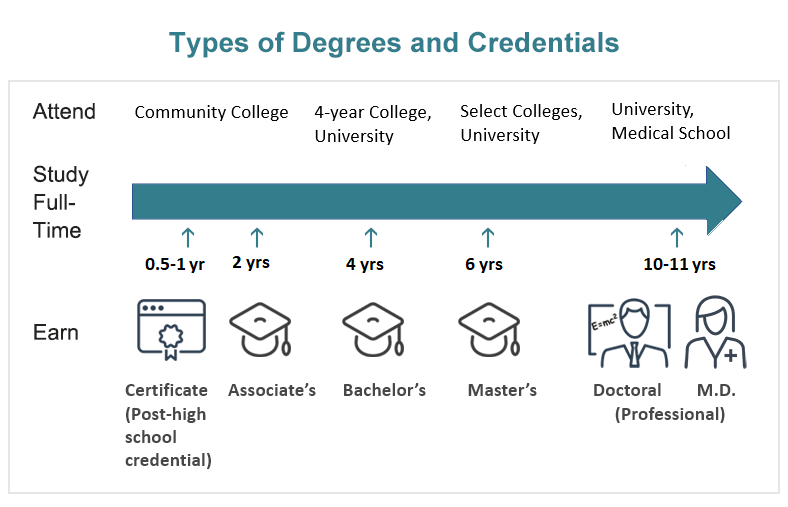
Traditional education programs for kindergarten and elementary school teachers include courses designed specifically for those preparing to teach. These courses include mathematics, physical science, social science, music, art, and literature, as well as prescribed professional education courses, such as philosophy of education, psychology of learning, and teaching methods. Aspiring secondary school teachers most often major in the subject they plan to teach while also taking a program of study in teacher preparation. Many 4-year colleges require students to wait until their sophomore year before applying for admission to teacher education programs. To maintain their accreditation, teacher education programs are now required to include classes in the use of computers and other technologies. Most programs require students to perform a student-teaching internship. Teacher education programs are accredited by the National Council for Accreditation of Teacher Education and the Teacher Education Accreditation Council. Graduation from an accredited program is not necessary to become a teacher, but it may make fulfilling licensure requirements easier.
Many States now offer professional development schools, which are partnerships between universities and elementary or secondary schools. Professional development schools merge theory with practice and allow the student to experience a year of teaching firsthand, under professional guidance. Students enter these 1-year programs after completion of their bachelor's degree.
Licensure and certification. All 50 states and the District of Columbia require public school teachers to be licensed. Licensure is not required for teachers in most private schools. Usually licensure is granted by the State Board of Education or a licensure advisory committee. Teachers may be licensed to teach the early childhood grades (usually preschool through grade 3); the elementary grades (grades 1 through 6 or 8); the middle grades (grades 5 through 8); a secondary-education subject area (usually grades 7 through 12); or a special subject, such as reading or music (usually grades kindergarten through 12).
Companies That Hire Math Teachers
Try it Out with an Activity or Project
STEM Activities
STEM activities are fun hands-on explorations that usually take from 10 minutes to one hour and use readily available household or classroom materials while introducing you to STEM concepts common in this career.
/-/https/www.sciencebuddies.org/cdn/Files/14536/5/perimeter-magic-triangle-with-pennies.jpg)
/-/https/www.sciencebuddies.org/cdn/Files/14299/6/diameter-circumference-three-circles-thumbnail.jpg)
Science Project Ideas
Project Ideas are in-depth STEM explorations that have a strong focus on controlling variables, taking accurate measurements, and analyzing data suitable for investigating the scientific method or the engineering design process.
/-/https/www.sciencebuddies.org/cdn/Files/6154/11/Kaleidoscope-image.jpg)
/-/https/www.sciencebuddies.org/cdn/Files/12138/4/piaget-thumbnail.jpg)
/-/https/careerdiscovery.sciencebuddies.org/Dirs/37/0/img/thumbnail.png)
On the Job
Role Models

Nature of the Work
Teachers play an important role in fostering the intellectual and social development of children during their formative years. The education that teachers impart plays a key role in determining the future prospects of their students. Whether in preschools or high schools or in private or public schools, teachers provide the tools and the environment for their students to develop into responsible adults.
Teachers act as facilitators or coaches, using classroom presentations or individual instruction to help students learn and apply concepts in a subject, such as mathematics. They plan, evaluate, and assign lessons; prepare, administer, and grade tests; listen to oral presentations; and maintain classroom discipline. Teachers observe and evaluate a student's performance and potential and increasingly are asked to use new assessment methods. Teachers also grade papers, prepare report cards, and meet with parents and school staff to discuss a student's academic progress or personal problems.
Many math teachers use a "hands-on" approach that uses "props" or "manipulatives" to help children understand abstract concepts, solve problems, and develop critical thought processes. For example, they teach the concepts of numbers or of addition and subtraction by playing board games. As the children get older, teachers use more sophisticated materials, such as science apparatus, cameras, or computers. They also encourage collaboration in solving problems by having students work in groups to discuss and solve problems together. To be prepared for success later in life, students must be able to interact with others, adapt to new technology, and think through problems logically.
Middle school teachers and secondary school teachers help students delve more deeply into subjects introduced in elementary school and expose them to more information about the world. Middle and secondary school teachers specialize in a specific subject, such as mathematics.
In addition to conducting classroom activities, teachers oversee study halls and homerooms, supervise extracurricular activities, and accompany students on field trips. They may identify students with physical or mental problems and refer the students to the proper authorities. Secondary school teachers occasionally assist students in choosing courses, colleges, and careers. Teachers also participate in education conferences and workshops.
Computers play an integral role in the education teachers provide. Resources such as educational software and the Internet expose students to a vast range of experiences and promote interactive learning. Students also use the Internet for individual research projects and to gather information. Computers are used in other classroom activities as well, from solving math problems to learning English as a second language. Teachers also may use computers to record grades and perform other administrative and clerical duties. They must continually update their skills so that they can instruct and use the latest technology in the classroom.
Teachers often work with students from varied ethnic, racial, and religious backgrounds. With growing minority populations in most parts of the country, it is important for teachers to work effectively with a diverse student population. Accordingly, some schools offer training to help teachers enhance their awareness and understanding of different cultures. Teachers may also include multicultural programming in their lesson plans, to address the needs of all students, regardless of their cultural background.
In recent years, site-based management, which allows teachers and parents to participate actively in management decisions regarding school operations, has gained popularity. In many schools, teachers are increasingly involved in making decisions regarding the budget, personnel, textbooks, curriculum design, and teaching methods.
Work Environment
Seeing students develop new skills and gain an appreciation of knowledge and learning can be very rewarding. However, teaching may be frustrating when one is dealing with unmotivated or disrespectful students. Occasionally, teachers must cope with unruly behavior and violence in the schools. Teachers may experience stress in dealing with large classes, heavy workloads, or old schools that are run down and lack many modern amenities. Accountability standards also may increase stress levels, with teachers expected to produce students who are able to exhibit satisfactory performance on standardized tests in core subjects. Many teachers, particularly in public schools, are also frustrated by the lack of control they have over what they are required to teach.
Teachers in private schools generally enjoy smaller class sizes and more control over establishing the curriculum and setting standards for performance and discipline. Their students also tend to be more motivated, since private schools can be selective in their admissions processes.
Teachers are sometimes isolated from their colleagues because they work alone in a classroom of students. However, some schools allow teachers to work in teams and with mentors to enhance their professional development.
Including school duties performed outside the classroom, many teachers work more than 40 hours a week. Part-time schedules are more common among preschool and kindergarten teachers. Although most school districts have gone to all-day kindergartens, some kindergarten teachers still teach two kindergarten classes a day. Most teachers work the traditional 10-month school year with a 2-month vacation during the summer. During the vacation break, those on the 10-month schedule may teach in summer sessions, take other jobs, travel, or pursue personal interests. Many enroll in college courses or workshops to continue their education. Teachers in districts with a year-round schedule typically work 8 weeks, are on vacation for 1 week, and have a 5-week midwinter break. Preschool teachers working in day care settings often work year round.
Most states have tenure laws that prevent public school teachers from being fired without just cause and due process. Teachers may obtain tenure after they have satisfactorily completed a probationary period of teaching, normally 3 years. Tenure does not absolutely guarantee a job, but it does provide some security.
More Information
Ask Questions
Do you have a specific question about a career as a Math Teacher that isn't answered on this page? Post your question on the Science Buddies Ask an Expert Forum.
Additional Resources
- American Federation of Teachers: https://www.aft.org/
- National Education Association: www.nea.org
- National Council for Accreditation of Teacher Education: www.ncate.org
- Council for Higher Education Accreditation: https://www.chea.org/
- National Center for Alternative Certification: https://teach-now.edu/
- National Board for Professional Teaching Standards: https://www.nbpts.org/
- Teacher.org - How to Become a Science Teacher: https://www.teacher.org/career/science-teacher/
Sources
- U.S. Bureau of Labor Statistics BLS (2024). Occupational Outlook Handbook (OOH), 2024 Edition, Bureau of Labor Statistics. Retrieved August 25, 2025.
- National Center for O*NET Development O*Net Online (2024). National Center for O*Net Development. Retrieved August 25, 2025
- NNSTOY. (2015). 2009 National Teacher of the Year Finalist. Retrieved January 25, 2017.
- California Charter Schools Association, YouTube. (2014, March 4). 2014 Hart Vision Teacher of the Year: Brittany Barnes. Retrieved February 24, 2021.
- Chun, K. (2007, August 8). Kelvin YS Chun—Educator, Magician, Balloonologist & Kite. Retrieved September 1, 2009.
- MathRaps, YouTube. (2008, June 30). San Diego County Board of Education. The Rappin' Mathematician Decimals. Retrieved January 20, 2010.